How will IFRS 18 impact the classification of interest and dividends in your statement of cash flows
How will IFRS 18 impact the classification of interest and dividends in your statement of cash flows
IFRS 18 Presentation and Disclosure in Financial Statements, the new financial statements presentation standard that replaces IAS 1 Presentation of Financial Statements, affects more than income and expense classification in the statement of profit or loss. There are also consequential changes to IAS 7 Statement of Cash Flows.
IFRS 18 is effective for annual reporting periods beginning on or after 1 January 2027, except for not-for-profit entities and superannuation entities applying AASB 1056 Superannuation Entities, who have a one-year delay.
How does IFRS 18 affect the statement of cash flows?
The introduction of IFRS 18 has flow-on effects on how entities prepare their statements of cash flows. One of the main changes relates to the way interest and dividends (both received and paid) are classified, with different rules depending on whether the entity has specified main business activities (SMBAs).
Classification of interest and dividend cash flows – entities without SMBAs
Under IFRS 18, entities no longer have a choice to classify interest and dividends received and paid as either cash flows from operating, investing or financing activities, consistently from one period to another. The consequential amendments to IAS 7 remove this presentation choice for entities without SMBAs.
The table below shows how the adoption of IFRS 18 may change the classification of cash flows from interest and dividends for an entity without SMBAs.
|
Cash flows |
Classification prior to adoption of IFRS 18 |
Classification after the adoption of IFRS 18 |
|
Interest paid |
Operating o r financing |
Financing |
|
Interest received |
Operating or investing |
Investing |
|
Dividends received |
Operating or investing |
Investing |
|
Dividends paid |
Operating or investing |
Financing |
Post-IFRS 18 adoption:
- Interest paid continues to be presented in the statement of cash flows, regardless of whether it has been recognised as an expense in profit or loss or capitalised in accordance with IAS 23 Borrowing Costs, and will be classified as cash flows from financing activities
- Dividends paid will always be classified as cash flows from financing activities
- Interest and dividends received will always be classified as cash flows from investing activities.
There is no longer an option to present any of these items as part of operating cash flows for entities without SMBAs.
What’s changed?
Entities that are currently splitting classification of interest and dividend payments and receipts across categories will, under IFRS 18, have to reclassify these into the categories specified in the table above.
Entities without SMBAs will not be able to classify any interest and dividend receipts and payments as operating cash flows.
Entities that may have previously classified interest capitalised to property, plant and equipment (PPE) as a cash flow from investing activities will have to reclassify these to financing activities under IFRS 18.
Classification of interest and dividend cash flows – entities SMBAs
The rules for entities with SMBAs are more complicated because they may classify interest and dividend cash flows in more than one category in the statement of profit or loss. Entities with SMBAs typically include banks, investment companies, insurance companies, financial institutions and entities that provide financing to customers to enable customers to buy the entity’s products.
After the adoption of IFRS 18, the general rule for classifying interest received and paid and dividends received is that:
- The entity must refer to how it classifies dividend income, interest income and interest expense in the statement of profit or loss, and
- The total of each of these cash flows must be classified in a single category in the statement of cash flows as either operating, investing or financing, with no splitting allowed for each type of cash flow.
The entity classifies the total of each cash flow type in a single category in the statement of profit or loss
If the entity classifies interest income, interest expense, and dividend income individually into a single category in the statement of profit or loss, this will determine how they are classified in the statement of cash flows.
Example: If a bank applies the accounting policy available under paragraph 66 of IFRS 18 and classifies all its interest expenses in the operating category in the statement of profit or loss, it classifies all its interest paid as cash flows from operating activities.
The entity classifies the total of each cash flow type in multiple categories in the statement of profit or loss
Because of the general rule to classify each of interest income, interest expense and dividend income in a single category in the statement of cash flows, in circumstances where an entity classifies one of these in more than one category in the statement of profit or loss (for instance, where an entity doesn’t apply the accounting policy choice available under paragraph 66 of IFRS 18 and classifies interest expense between the operating and financing categories subject to the nature of the associated liability), the entity must make an accounting policy choice to classify all of the cash flows attributable to the ‘split’ profit or loss amounts in one of the applicable categories in the statement of cash flows.
Example: If a bank classifies interest expenses in both the operating category and the financing category in the statement of profit or loss, it must make an accounting policy choice to classify all its interest paid as either cash flows from operating activities or cash flows from financing activities. A similar accounting policy choice will need to be made if interest income and dividend income is recognised in more than one profit or loss category.
What’s changed for investment property entities?
Entities that invest in particular types of assets as a main business activity (for example, investment property such as commercial real estate) have a SMBA, and would account for income and expenses in the statement of profit or loss under IFRS 18 as follows:
- Rental income: Operating
- Fair value gains and losses on investment properties: Operating
- Interest expense on bank loans used to fund the acquisition of properties: Financing (assuming the entity does not provide financing to customers as a main business activity).
Accordingly, a commercial real estate entity that does not have an SMBA of providing financing to customers and has borrowings to fund its property acquisitions classifies all its interest expense (that is, interest expense arising from those borrowings as well as other interest expense recognised under other IFRS Accounting Standards, such as interest expense arising from lease labilities) in a single category in the statement of profit or loss, i.e. the financing category. It therefore classifies all its interest paid in the statement of cash flows as financing activities.
Investment property entity - Example for interest paid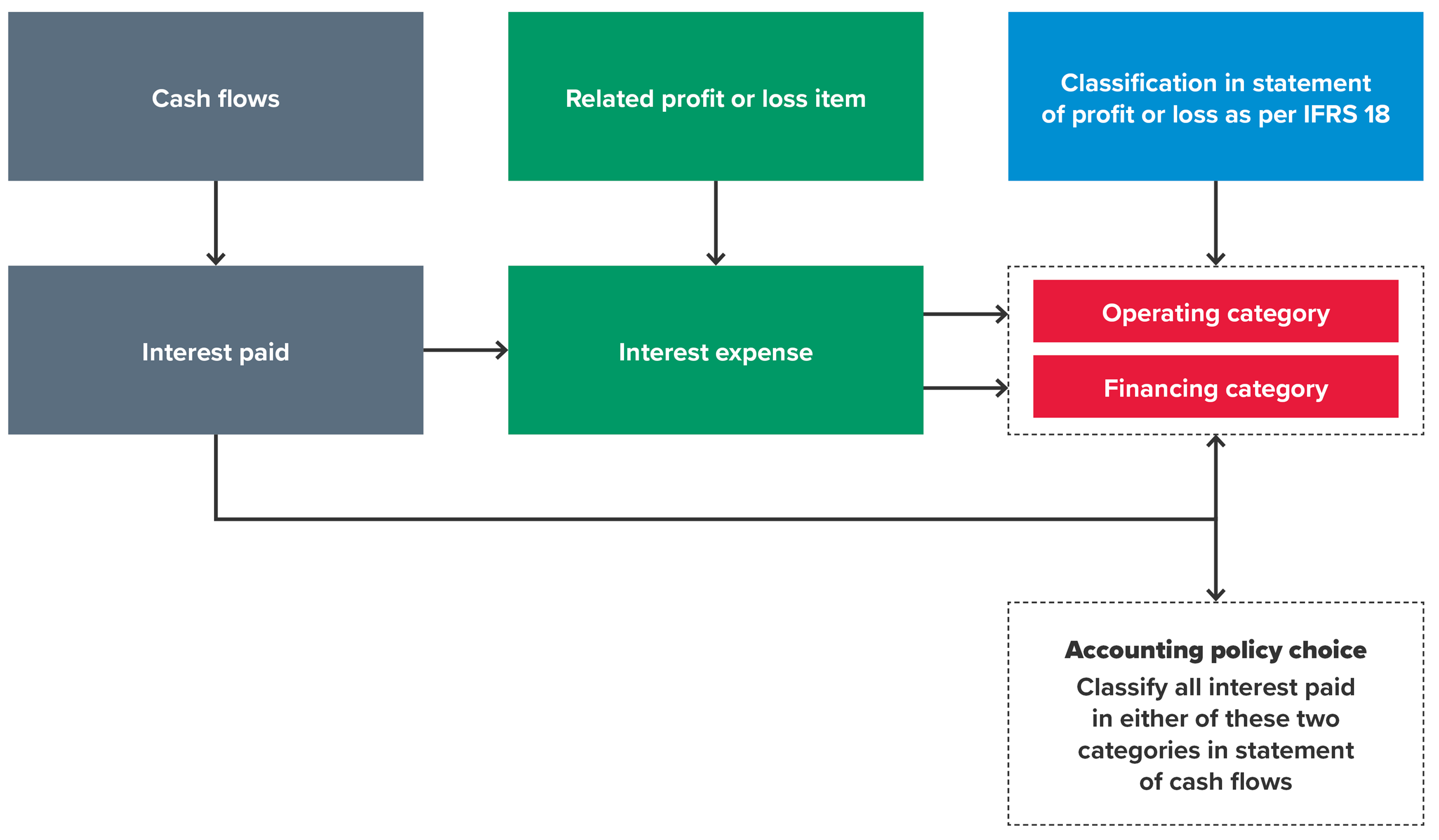
Similarly, if the investment property entity classifies interest and dividend income in the investing category in profit or loss under IFRS 18 because these items relate to assets that are not a main business activity of the investment property entity, the entity will classify those receipts as cash flows from investing activities.
What’s changed for banks?
Banks and other entities that provide financing to customers as a main business activity have a SMBA. Interest expense for these entities for ‘Type 1 liabilities’ (i.e. liabilities that arise from transactions that involve only the raising of finance) is classified in the statement of profit or loss under IFRS 18 as follows:
- If it relates to providing financing to customers: Operating
- If it does not relate to providing financing to customers: Operating to financing, depending on the entity’s accounting policy choice.
Assuming the entity chooses, or is required to, recognise interest expense across two categories in profit or loss (e.g. banks that have both Type 1 and Type 2 liabilities), it must make an accounting policy choice and select a single category for the statement of cash flows. That is, it must either classify all interest payments as cash flows from operating activities or all as cash flows from financing activities.
Banks and financial institutions - Example for interest paid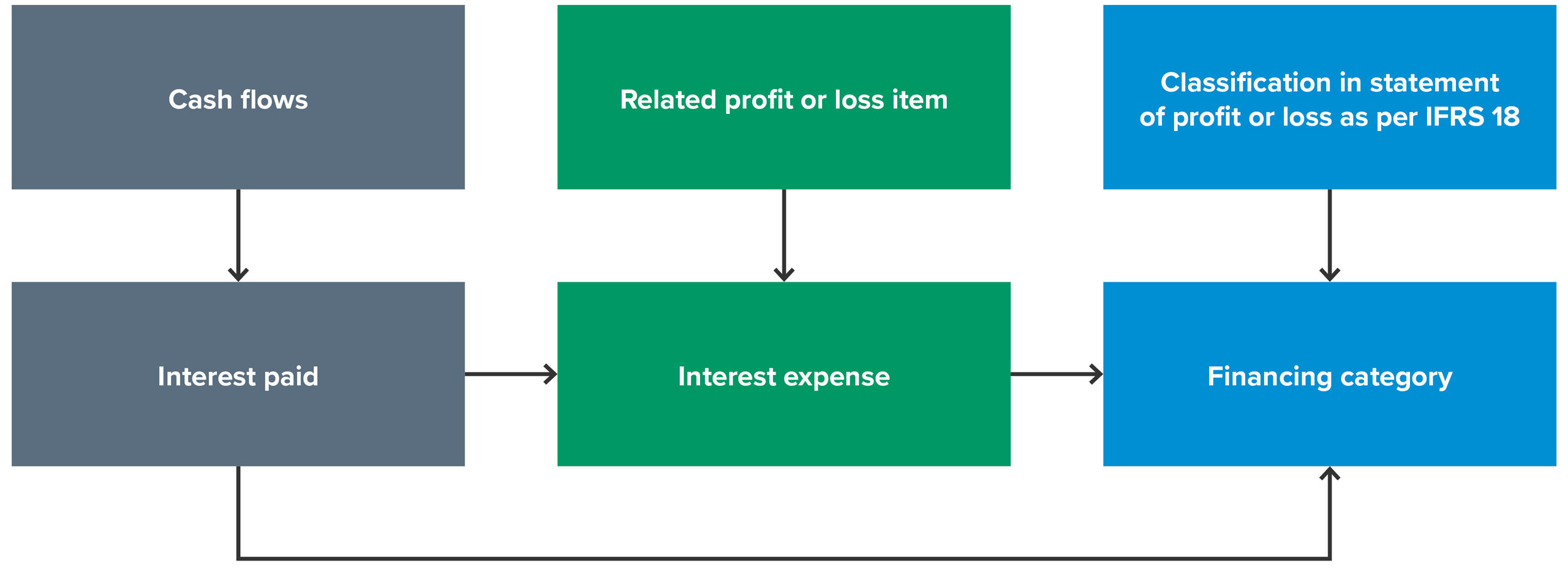
Key points
- An entity must classify all cash flows from each of these three items (interest received, interest paid and dividends received) in a single line item in the statement of cash flows.
- The cash flows cannot be subdivided or ‘split’ into more than one activity. For example, an entity may classify interest expense in more than one line item in the statement of profit or loss; however, entities are not permitted to classify the related cash flows (e.g. interest paid) in more than one category in the statement of cash flows.
What’s changed if capitalised interest was previously classified as cash flows from investing activities?
Entities may have historically classified interest capitalised into the carrying amount of assets such as property, plant and equipment, applying IAS 23 Borrowing Costs as investing cash flows. This assisted comparison to other notes in the financial statements (e.g. the property, plant and equipment reconciliation required by IAS 16 Property, Plant and Equipment).
On the adoption of IFRS 18, and the consequential amendments to IAS 7, capitalised interest paid can no longer be classified as investing cash flows. This is because operating or financing is the only classification possibility for interest paid, depending on whether an entity has a specified main business activity of providing financing to customers and related accounting policy choices.
Assessing the impact on your statement of cash flows
For some entities, IFRS 18 will result in significant reclassification of interest and dividend cash flows, particularly where existing accounting policies rely on presentation alternatives currently available under IAS 7. Understanding these changes early can help simplify transition planning and future comparative disclosures.
For more information, explore our IFRS 18 resources or speak with our team of experts.