IFRS 18: The clock is ticking – Impacts on your operating profit
IFRS 18: The clock is ticking – Impacts on your operating profit
With IFRS 18 Presentation and Disclosure in Financial Statements superseding IAS 1 Presentation of Financial Statements for annual reporting periods beginning on or after 1 January 2027, the ‘clock is ticking’ for entities to assess the effects of this new standard on their financial statements.
For entities with calendar year-ends, the 31 December 2027 annual financial statements (and any interim financial statements prepared during 2027, such as 30 June 2027 half-year financial statements) will reflect the effects of IFRS 18 on the primary financial statements and related notes. Although IFRS 18 does not affect the recognition and measurement requirements of IFRS® Accounting Standards, its effects on financial statements should not be underestimated.
This article demonstrates how the IFRS 18 requirements to classify income and expenses into one of five categories, and present a mandatory sub-total for ‘operating profit’, could impact what the statement of profit or loss looks like (in particular, your operating profit) for entities without specified main business activities.
Implementation of this aspect of IFRS 18 may require changes to system mapping, reporting processes, performance metrics, covenants and external communications (for example, where the entity uses management-defined performance measures (MPMs) in its commentary about the financial statements to explain changes in the structure of its statement of profit or loss).
Example 1: Changes in previously reported operating profit
Based on Scenario 1 in our publication.
Entity A is a for-profit manufacturing group that has historically presented an ‘operating profit’ subtotal in its statement of profit or loss.
Entity A does not have either specified main business activity of investing in assets or providing financing to customers.
Management defined this operating profit subtotal by excluding the following items that it considered not reflective of the entity’s underlying performance:
- Government grant income to support employees in the trades
- Expected credit losses on trade receivables
- Goodwill impairment.
Management also included the following in operating income:
- Fair value movements in investment property (vacant land held for uncertain future use that the entity accounts for using the fair value model in IAS 40 Investment Property)
- Interest income from significant cash and cash equivalents held by the treasury department of the entity.
Operating profit is a KPI used by investors and Entity A’s board of directors.
Impacts of IFRS 18
IFRS 18, paragraph 69(a) requires a mandatory ‘operating profit or loss’ subtotal to be included in the statement of profit or loss. Operating profit or loss comprises all income and expenses classified as operating, a residual category. That is, items of income and expenses are classified as ‘operating’ if they do not meet the requirements to be classified in either the investing, financing, income taxes, or discontinued operations categories.
The table below shows how the IFRS 18 classification requirements will impact Entity A’s operating profit:
|
Income and expenses |
Classification under IAS 1 |
Classification under IFRS 18 |
Reason |
Impact on previously stated operating profit |
|
Government grant income to support employees in the trades |
Not in operating profit |
Operating |
The government grant does not relate to income from assets specified in paragraph 53, i.e. it is not income from:
The grants relate to Entity A’s operating expenses (employee salaries). Refer to IFRS 18, paragraph 52 |
Increase |
|
Expected credit losses on trade receivables |
Not in operating profit |
Operating |
Trade receivables are assets that Entity A uses in combination with other assets to produce or supply goods or services; i.e. they do not generate a return individually and largely independently of the entity’s other resources. Therefore, expenses arising from the subsequent measurement of trade receivables are classified in the operating category. Refer to IFRS 18, paragraph B48(b), B49(d) |
Decrease |
|
Goodwill impairment |
Not in operating profit |
Operating |
Goodwill is an asset that Entity A uses in combination with other assets to produce or supply goods or services; i.e. it does not generate a return individually and largely independently of the entity’s other resources. Therefore, expenses arising from subsequent measurement of goodwill are classified in the operating category. Refer to IFRS 18, paragraph B48, B49(d) |
Decrease |
|
Fair value movements in investment property (vacant land held for uncertain future use) |
Included in operating profit |
Investing |
Land held for an undetermined future use is classified as investment property under IAS 40 Investment Property. As Entity A does not have a specified main business activity of investing in investment properties, these assets generate a return individually and largely independently of the entity’s other resources. Therefore, fair value gains and losses on the investment property are classified in the investing category. Refer to IFRS 18, paragraph 53(c), 54(b), B46(b), B47(f) |
Decrease |
|
Interest income from significant cash and cash equivalents held by the treasury department of the entity |
Included in operating profit |
Investing |
As Entity A does not have a specified main business activity, income from cash and cash equivalents is classified in the investing category. Refer to IFRS 18, paragraph 53(b), 54(a) |
Decrease |
Depending on the amounts involved, Entity A’s operating profit could change significantly as a result of these changes.
Other action items for management to consider include:
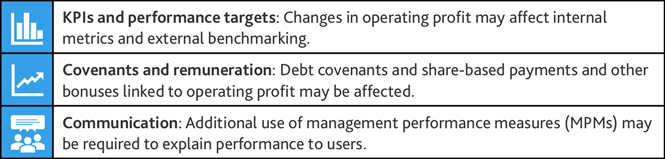
Source: BDO International Financial Reporting Bulletin 2026/03 (Scenario 1)
Example 2: Finance costs
Based on Scenario 2 in our publication.
Entity B is a for-profit retail group that has historically presented a ‘finance costs’ line item in profit or loss, which includes the following expenses:
- Interest expense
- Credit card processing fees
- Foreign exchange losses on trade receivables.
Finance costs were excluded from operating profit, resulting in a higher operating profit subtotal used internally and also communicated to shareholders.
Impacts of IFRS 18
IFRS 18 removes the undefined concept of ‘finance costs’. Instead, entities classify these costs in the ‘financing’ category only when they meet specific criteria. Otherwise, they are shown in the operating category (by default).
The table below shows how the IFRS 18 classification requirements will impact Entity B’s operating profit:
|
Income and expenses |
Classification under IAS 1 |
Classification under IFRS 18 |
Reason |
Impact on previously stated operating profit |
|
Interest expense on borrowings |
Not in operating profit |
Financing |
The borrowings arise from a transaction that involves only the raising of finance. Refer to IFRS 18, paragraph 59(a), 60(a) |
No change |
|
Credit card processing fees |
Not in operating profit |
Operating |
Does not comprise ‘interest expense’ for a liability from a transaction that does not involve only the raising of finance. Refer to IFRS 18, paragraph 52 |
Decrease |
|
Foreign exchange loss on trade receivables |
Not in operating profit |
Operating |
Foreign exchange differences must be classified in the same category as the income and expenses from the items that gave rise to the foreign exchange difference. The foreign exchange difference relates to trade receivables, which do not generate a return individually and largely independently of the entity’s other resources. Refer to IFRS 18, paragraph B66(a) |
Decrease |
Entity B’s operating profit will decrease under IFRS 18 with the foreign exchange losses and credit card processing fees now recognised in operating profit.
Points to note for Entity B’s management:
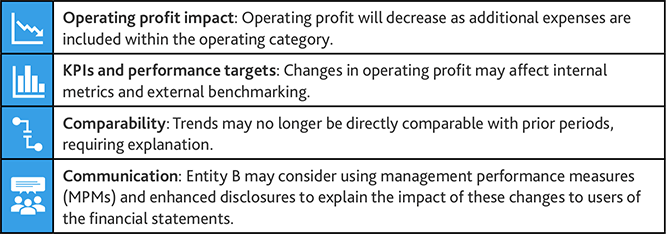
Source: BDO International Financial Reporting Bulletin 2026/03 (Scenario 2)
Example 3: Associates and joint ventures accounted for using the equity method
Based on Scenario 3 in our publication.
Entity C is a for-profit manufacturing group that has historically held investments in associates and joint ventures that are integral to its operations. For example, Entity C purchase key components from an associate that manufactures parts used in its production process.
Under IAS 1, Entity C includes its share of profit or loss from associates and joint ventures accounted for using the equity method in operating profit, as they are integral to its core business activities.
Operating profit is a KPI used in communications with investors and management.
Impacts of IFRS 18
IFRS 18 requires that income and expenses from investments in associates and joint ventures be classified in the investing category.
The table below shows how the IFRS 18 classification requirements will impact Entity C’s operating profit:
|
Income and expenses |
Classification under IAS 1 |
Classification under IFRS 18 |
Reason |
Impact on previously stated operating profit |
|
Profit or loss from investments in associates and joint ventures accounted for using the equity method |
Included in operating profit |
Investing |
Entity C is not investing in associates and joint ventures as a specified main business activity. Rather, these investments are integral to Entity C’s operations. Income must be classified in the investing category. Refer to IFRS 18, paragraph 53(a), 54(a) |
Decrease |
Entity C’s operating profit will decrease under IFRS 18 because gains from the investments in associates and joint ventures are now recognised in the investing category.
Other action items for management to consider include:
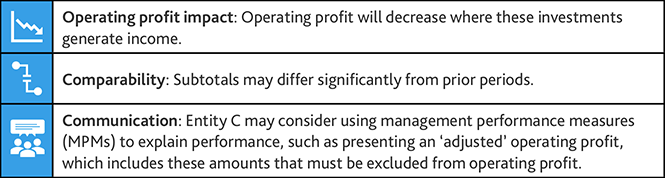
Source: BDO International Financial Reporting Bulletin 2026/03 (Scenario 3)
Example 4: Foreign exchange differences
Based on Scenario 4 in our publication.
Entity D is a for-profit multinational group that has historically aggregated all foreign exchange gains and losses into a single line item within profit or loss, excluding it from operating profit. The line item includes foreign exchange differences on:
- Trade receivables and payables
- Financial assets (investments)
- Loans (borrowings).
Entity D has no specified main business activities.
Impacts of IFRS 18
Foreign exchange differences must be classified in the same category as the income and expenses from the items that gave rise to the foreign exchange difference.
The table below shows how the IFRS 18 classification requirements will impact Entity D’s operating profit:
|
Income and expenses |
Classification under IAS 1 |
Classification under IFRS 18 |
Reason |
Impact on previously stated operating profit |
|
Foreign exchange differences relating to trade receivables and payables |
Not in operating profit |
Operating |
Foreign exchange differences arising from operating items, such as trade receivables and payables, are classified in the operating category. Refer to IFRS 18, paragraph B65 |
Depending on amounts and directional impacts |
|
Foreign exchange differences on financial assets (where Entity D is not investing in these assets as a main business activity) |
Not in operating profit |
Investing |
Entity D does not have a specified main business activity of investing in these financial assets, and these financial assets generate returns individually and largely independently of the entity’s other resources. Therefore, foreign exchange differences must be classified in the same category as the income and expenses from these items (i.e. investing). Refer to IFRS 18, paragraph B65, 53(c), 54(b), B46(a) |
No change |
|
Loans (borrowings) |
Not in operating profit |
Financing |
These loans arise from transactions that involve only the raising of finance, and Entity D does not provide financing to customers as a main business activity. Therefore, the foreign exchange differences must be classified in the same category as the income and expenses from these items, such as interest expense (i.e. financing). |
No change |
While Entity D’s operating profit may only increase or decrease for the ‘operating’ portion noted above for trade receivables and payables, Entity D needs to ensure that it is able to disaggregate these amounts for presentation in the statement of profit or loss.
Other points for management to consider include:
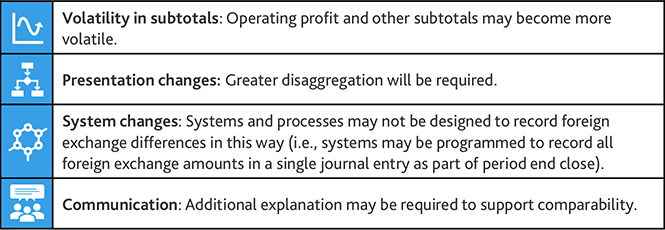
Source: BDO International Financial Reporting Bulletin 2026/03 (Scenario 4)
Example 5: Expenses related to income-generating assets
Based on Scenario 7 in our publication.
Entity G holds investment properties that generate rental income. Entity G accounts for the investment property in accordance with the fair value model in IAS 40 Investment Property and therefore recognises fair value gains and losses in its profit or loss. Entity G, however, has determined it does not have a main business activity of investing in investment properties.
Entity G has included rental income and fair value gains and losses in operating profit under IAS 1.
Historically, Entity G has also presented expenses related to the investment properties, such as cleaning and maintenance, and management fees payable to third parties, as part of operating profit.
Impacts of IFRS 18
IFRS 18 limits the types of income and expenses that may be classified in the investing category. Assuming that Entity G does not invest in investment properties as a main business activity, the following table shows how the IFRS 18 classification requirements will impact Entity G’s operating profit:
|
Income and expenses |
Classification under IAS 1 |
Classification under IFRS 18 |
Reason |
Impact on previously stated operating profit |
|
Rental income from investment property |
Included in operating profit |
Investing |
The investment properties generate a return individually and largely independently of the entity’s other resources. Therefore, rental income from the investment properties is classified in the investing category. Refer to IFRS 18, paragraph 53(c), 54(a), B46(b), B47(c) |
Decrease |
|
Fair value movements on investment properties |
Included in operating profit |
Investing |
The investment properties generate a return individually and largely independently of the entity’s other resources. Therefore, fair value gains and losses on the investment property are classified in the investing category. Refer to IFRS 18, paragraph 53(c), 54(b), B46(b), B47(f) |
Decrease |
|
Cleaning and maintenance costs |
Included in operating profit |
Operating |
Although investment properties are assets that generate a return individually and largely independently of the entity’s other resources, these costs are not included in the types of expenses classified in the investing category. That is, they are not:
Refer to IFRS 18, paragraph 54(a), 54(b) |
No change |
|
Management fees paid to third parties |
Included in operating profit |
Operating |
Explanation as above for cleaning and maintenance costs. |
No change |
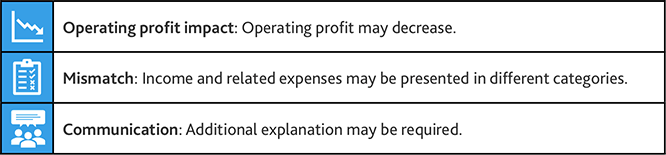
There will be a ‘mismatch’ in Entity G’s operating profit under IFRS 18 because property income is classified in the investing category, while property expenses are deducted from operating profit.
In this regard, management should also consider the following:
Source: BDO International Financial Reporting Bulletin 2026/03 (Scenario 7)
More information
IFRB 2026/03 IFRS 18 - the clock is ticking - practical effects on financial reporting provides more examples of instances where changes to operating profit could result from IFRS 18 implementation.
Need help?
Our recent articles on IFRS 18 demonstrate the complexity of applying IFRS 18 in practice. Reach out to our team of experts for assistance with understanding the latest requirements in IFRS 18.