Time to clean up your accounting policies
Time to clean up your accounting policies
With the Australian Securities and Investments Commission (ASIC) focussing on financial reports as a means of surveillance (including ‘please explain’ letters) on the accounting treatments of both listed and unlisted entities, it is more important than ever that your financial statements say what they mean in order to reduce the chance of raising ‘red flags’ for ASIC. Our article highlights eight ways to do this.
ASIC focuses on areas where significant judgement is required, such as revenue recognition, asset impairment, and recognition and measurement of financial instruments, and it also looks for consistency between the financial report and other parts of the annual report, such as the Operating and Financial Review (OFR).
Avoiding information overload, being concise and entity-specific, avoiding technical jargon by using plain English where possible, avoiding repetition of information, and ensuring consistency and linkages across all the information in the annual report are key.
As part of this ‘clean up’, an easy win can be your accounting policies. Many entities still present accounting policy information for every possible transaction or balance, merely repeating the requirements of the accounting standards. Their accounting policies are also ‘boilerplate’, rather than explaining what the entity actually does.
Our article will show you how to take the leap towards streamlining your accounting policies, focussing only on material accounting policy information, particularly where significant judgements and estimation are involved.
What is material accounting policy information?
Accounting policy information is required for material transactions and balances where the accounting policy information is itself material. This is illustrated in the diagram below.
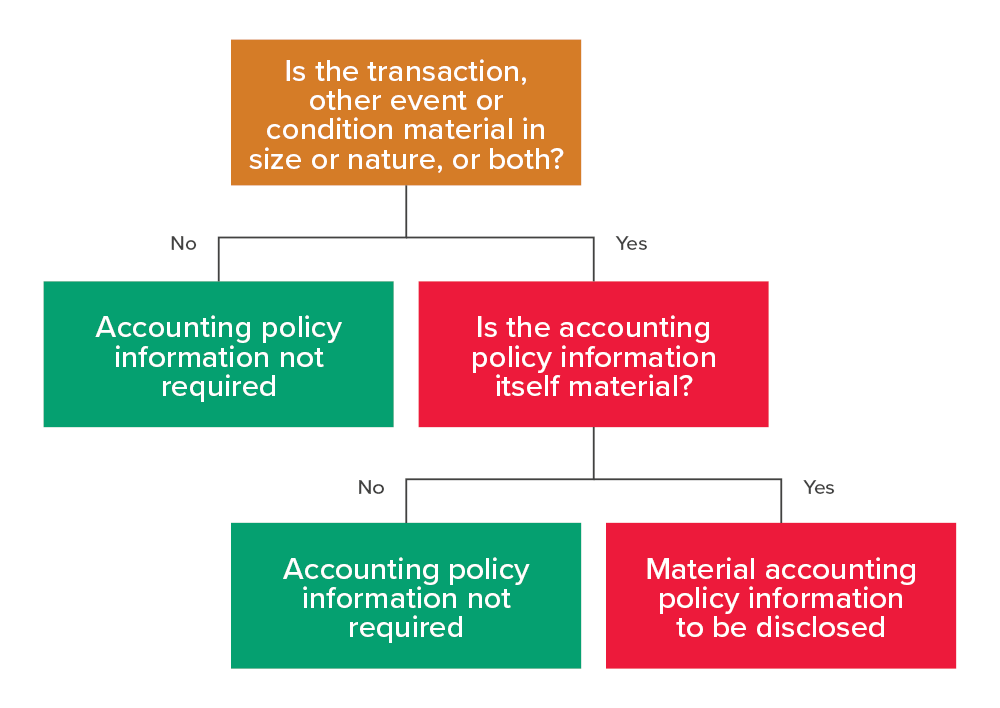
So, only material accounting policy information should be disclosed. Accounting policy disclosure is not required for:
- Immaterial transactions, other events or conditions (applying a quantitative and qualitative assessment)
- Material transactions, other events or conditions where the accounting policy information is not material.
When is accounting policy information expected to be material?
Accounting policy information is likely to be material if the information relates to material transactions, other events or conditions, and one of the following applies:
- The entity chose the accounting policy from one or more options permitted under IFRS® Accounting Standards (e.g. measuring investment property at historical cost or fair value)
- The accounting policy was developed applying the hierarchy in IAS 8 Accounting Policies, Changes in Accounting Estimates and Errors because no specific standard deals with the transaction
- The entity was required to make significant judgements or assumptions in applying the accounting policy, and these judgements or assumptions have been disclosed as required by IAS 1, paragraphs 122 or 125
- The accounting is complex, and users would otherwise not understand the material transaction (for example, if more than one standard applies to the transaction)
- The entity changed its accounting policy during the period, resulting in a material change to information reported in the financial statements.
No more ‘boilerplate’ accounting policies
Material accounting policy information focuses on how an entity has applied IFRS Accounting Standards to its circumstances. Boilerplate accounting policies that merely duplicate or summarise the accounting requirements of IFRS Accounting Standards should be removed because they clutter up the financial statements and may sometimes obscure material accounting policy information.
Examples of boilerplate accounting policies include items where there are no accounting policy choices involved, such as:
- Income taxes, except for the required disclosures if tax consolidation is applied
- Foreign currency translation
- Cash and cash equivalents
- Property, plant and equipment (PPE), except for the basis of recognition and the depreciation method applied
- Provisions for employee benefits
- Other provisions
- Current/non-current classification, etc.
Disclose entity-specific information (especially for revenue)
Many entities disclose a boilerplate revenue accounting policy based on the five-step approach outlined in IFRS 15 Revenue from Contracts with Customers. This information is not useful to users. Instead, for revenue recognition accounting policy information, we would expect to see:
- A bespoke policy for each material revenue stream in plain English
- Each bespoke policy aligning with the revenue categories disclosed for disaggregated revenue, as well as the OFR discussion
- Each bespoke policy explaining the timing of revenue recognition, including what the performance obligations are and when they are satisfied, and how revenue is recognised (point in time versus over time), and judgements involved as to the appropriate timing
- Judgements about how the entity allocated the transaction price to performance obligations.
Disclose policy options and estimates
Although material accounting policy information may not be required to explain how items of PPE are capitalised, and how revaluation increments and decrements are recognised, an entity would still be required to explain for material balances of PPE:
- Whether PPE is subsequently measured at cost or revaluation
- Depreciation method chosen (straight-line versus reducing balance)
- Useful lives of PPE assets.
This is because they are subject to policy options and estimation (useful lives).
Similar policy options exist for the methods used to measure share-based payments and inventory costs, subsequent measurement of investment property and exploration and evaluation assets, the tax consolidation allocation method applied, and tax funding and sharing arrangements, and the presentation of government grants related to assets on a gross or a net basis. The policy options chosen should be disclosed.
Disclose policy judgements
While there may be no choices in how to account for some of the above items, there may be significant judgements involved in their application, which must be disclosed. For example, when is revenue recognised, deferred tax assets recognised, development assets capitalised, etc?
We would also expect the material accounting policy information to address significant judgement disclosure about, amongst others, for example:
- Business combinations: Whether acquisition accounting, reverse acquisition accounting, or asset acquisition accounting applies
- Financial instruments: If judgemental, how the entity has met the solely payments of principal and interest test for recognising financial assets at amortised cost
- Joint arrangements: Whether the entity has joint control, and if judgemental, why it is accounted for as a joint venture or joint operation.
Remove superfluous accounting policies
Many entities currently disclose comprehensive accounting policy information for transactions and balances that they do not have in the current year, or the prior year. Typical examples include:
- Business combinations
- Accounting for foreign operations
- Financial liabilities measured at fair value through profit or loss
- Impairment
- Consolidation
- Non-current assets held for sale and discontinued operations.
These should be deleted as they comprise immaterial accounting policy information and could obscure material accounting policy information.
Simple steps, such as moving accounting policy information into the relevant note, can help this process. If there is no related note, then you know that the policy information is superfluous and should be deleted.
For the financial statements as at 30 June 2026, we therefore expect to see a large reduction in the number of accounting policies disclosed.
How to get started?
We recommend that entities avoid a last-minute rush and start streamlining their accounting policies now.
Firstly, remove all accounting policies that are completely redundant because the entity had none of these related transactions or balances during the period.
Then read each sentence of the remaining policies carefully. Working your way line by line, any information that comes straight out of an Accounting Standard can be deleted unless:
- It relates to an accounting policy choice
- It relates to an area where judgement is required
- It requires tailoring to explain the entity’s complex transaction (such as revenue), or
- It requires an explanation of how the entity developed an accounting policy under the hierarchy in IAS 8.
More information
To further improve the understandability of your financial statements for users, you may also be interested in our article, 8 ways to make your financial statements say what you mean.
Need help?
Please contact BDO’s IFRS & Corporate Reporting team if you require assistance with your accounting policy disclosure.