Diversifying housing for Australia’s seniors living sector
Diversifying housing for Australia’s seniors living sector
Australia’s seniors living sector is dealing with policy reforms, an aging population, consumer expectations, and a national housing crisis, creating urgent demand for new solutions. Operators, investors, and policymakers must adapt quickly to offer more choice, improve affordability, and integrate care and wellness services. The next decade will be defined by both challenge and opportunity. Here’s what’s driving the sector and where the smart money and innovation are heading.
Demographic changes and demand pressures
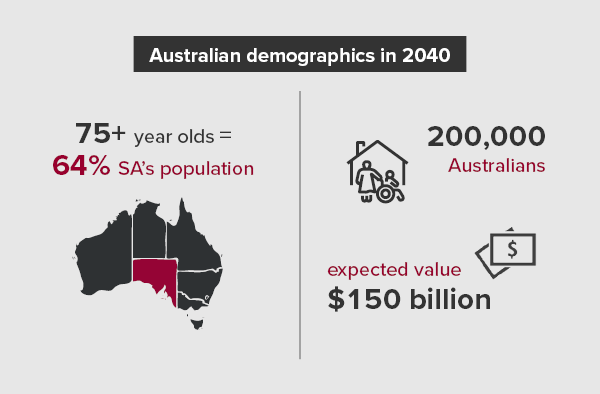
As with much of the globe, Australia’s population is aging rapidly. According to realestate.com.au, by 2040, the over 75 cohort will surge by 64 per cent in South Australia alone, with similar trends nationwide. This ‘silver tsunami' is driving unprecedented demand for age friendly housing, retirement villages, and care integrated communities. Yet supply is falling behind due to planning bottlenecks, land shortages, and capital constraints. This chronic mismatch between what older Australians need and what the market currently delivers creates an opportunity for operators to explore innovative models, partnerships, and advocacy for planning reform to unlock new supply.
Policy reform and essential infrastructure
Recent policy moves, including South Australia’s declaration of retirement villages as 'essential infrastructure', mark a significant step forward. Additionally, fast-tracked approvals for co-located retirement and aged care projects are setting a new national benchmark. The sector is also beginning to gain visibility in national housing targets and aged care reforms, reflecting its growing importance to Australia’s health, housing, and social systems.
Advocacy for harmonised, fit-for-purpose planning, and regulatory frameworks is critical. Operators should engage proactively with government to ensure the sector’s voice shapes the next wave of reforms.
Large-scale operators and consolidation
The sector is seeing the emergence of large-scale operators like The Living Co., Levande, and Baptistcare, which are all pursuing national scale through acquisition and development. Consolidation of this nature can bring efficiency, capital, and professionalism, but also raises questions about local character, consumer choice, and integration of care.
Scale enables investment in technology and service innovation. However, successful operators will balance efficiency with the preservation of community and resident autonomy.
Innovative offerings from assisted living to vertical villages
200,000 Australians are expected to embrace the assisted living model, creating a $150 billion market forecast. Vertical villages, land lease communities, and intergenerational precincts are also gaining traction, offering new lifestyle and affordability options. Operators like Levande are investing in premium, high-rise developments, while others focus on affordable, modular, or co-living models. There is an opportunity to diversify product offerings to meet the full spectrum of seniors’ needs from active, independent living to care integrated and affordable solutions.
Prevention, wellness, and the new value proposition
The future of the seniors living sector lies in prevention and wellness. As health and aged care systems face funding and workforce constraints, retirement living is increasingly positioned as preventative health in action, reducing hospital admissions, supporting independence, and enhancing quality of life. Residents are expecting more, with exercise programmes, social connection, dementia support, and carer services all becoming standard.
Operators who invest in wellness infrastructure, digital health, and private pay support services will differentiate themselves and drive long term value.
Affordability and the housing crisis
The national housing crisis is acute for seniors. Affordable rental supply is collapsing, and many older Australians are struggling to downsize or access suitable accommodation. Land lease communities and innovative rental models are filling some gaps, but more progress is needed, particularly for low income and vulnerable groups.
Partnerships with government, super funds, and community housing providers can open new supply and funding streams. Operators should also advocate for policy changes such as pension asset test reform and increased rent assistance to support downsizing and affordability.
Trust and professional standards
The sector is responding with higher standards, increased transparency, and a renewed focus on resident trust. Industry codes of conduct, dispute resolution, and harmonised regulation are all on the agenda.
Operators who lead on governance, resident engagement, and professional standards will build lasting reputational and commercial advantage.
Capital appetite and investment momentum
The sector is experiencing greater capital appetite, with investment flowing from superannuation funds, private equity, and international investors. This diversity of capital sources is accelerating development and supporting larger, more complex projects. However, it is also increasing the competition for quality assets and scale to match the burgeoning capital appetite. Operators who demonstrate strong governance and sustainable growth models will be best placed to attract and deploy capital effectively for long-term sector resilience.
A sector ready for leadership
Demand is rising, regulation is evolving, and expectations around affordability, care integration, and sustainability are increasing. Success will depend on diversifying offerings, strengthening governance, and building partnerships that enable scale and innovation. Those who plan and adapt early will be best positioned to deliver value for residents and maintain a competitive edge.
How BDO's project & infrastructure advisory can support your seniors living strategy
At BDO, we recognise that the seniors living sector is not a single market, but a dynamic ecosystem encompassing retirement villages, land lease communities, assisted living, aged care, and emerging hybrid models.
Our project & infrastructure advisory team brings integrated expertise across infrastructure delivery, financial analysis, valuation, and policy advisory to provide seniors living operators with practical, end-to-end support.
We help clients to:
- Develop and stress test business cases for new retirement living, aged care, and integrated precincts
- Manage risk in a complex regulatory environment
- Provide specialist valuations for seniors living assets, supporting transactions, financing, and strategic decision making
- Undertake feasibility studies, market analysis, and demand forecasting to ensure projects are viable and future proof
- Facilitate market soundings and government advocacy to accelerate approvals and secure policy support
- Support mergers, acquisitions, and partnerships from due diligence to integration so clients can scale with confidence
- Drive innovation in asset management, digital transformation, and operational excellence to enhance resident experience and long-term sustainability.
Whether you are seeking to expand, reposition, or future-proof your seniors living portfolio, our multidisciplinary team can help you seize the opportunities ahead and deliver lasting impact for your organisation and the communities you serve. Contact us.