Doubling proprietary company financial reporting thresholds could reduce sustainability reporting obligations
As part of its 2026–27 Budget regulatory reform agenda, the Australian Government announced plans to increase the thresholds for determining whether a proprietary company is large or small. The aim is to ensure that reporting requirements remain appropriate as businesses grow.
To give effect to this announcement, Treasury released draft regulations on 19 October 2026, proposing to increase the two monetary thresholds (revenue and gross assets) used in the large proprietary company test.
When will the new thresholds take effect?
The amendments to Regulation 1.0.02B will apply to financial years beginning on or after 1 July 2027.
What does this mean for financial reporting obligations?
A large proprietary company must lodge financial statements with the Australian Securities and Investments Commission (ASIC) if it meets two of the criteria outlined in the table below. Treasury’s draft regulations double the revenue and gross asset thresholds for financial years beginning on or after 1 July 2027, which would reduce the number of smaller proprietary companies required to prepare annual financial reports, directors’ reports, and sustainability reports.
|
Threshold |
Current section 45A thresholds |
Proposed new thresholds |
|
Revenue |
$50 million |
$100 million |
|
Gross assets |
$25 million |
$50 million |
|
Employees |
100 |
100 |
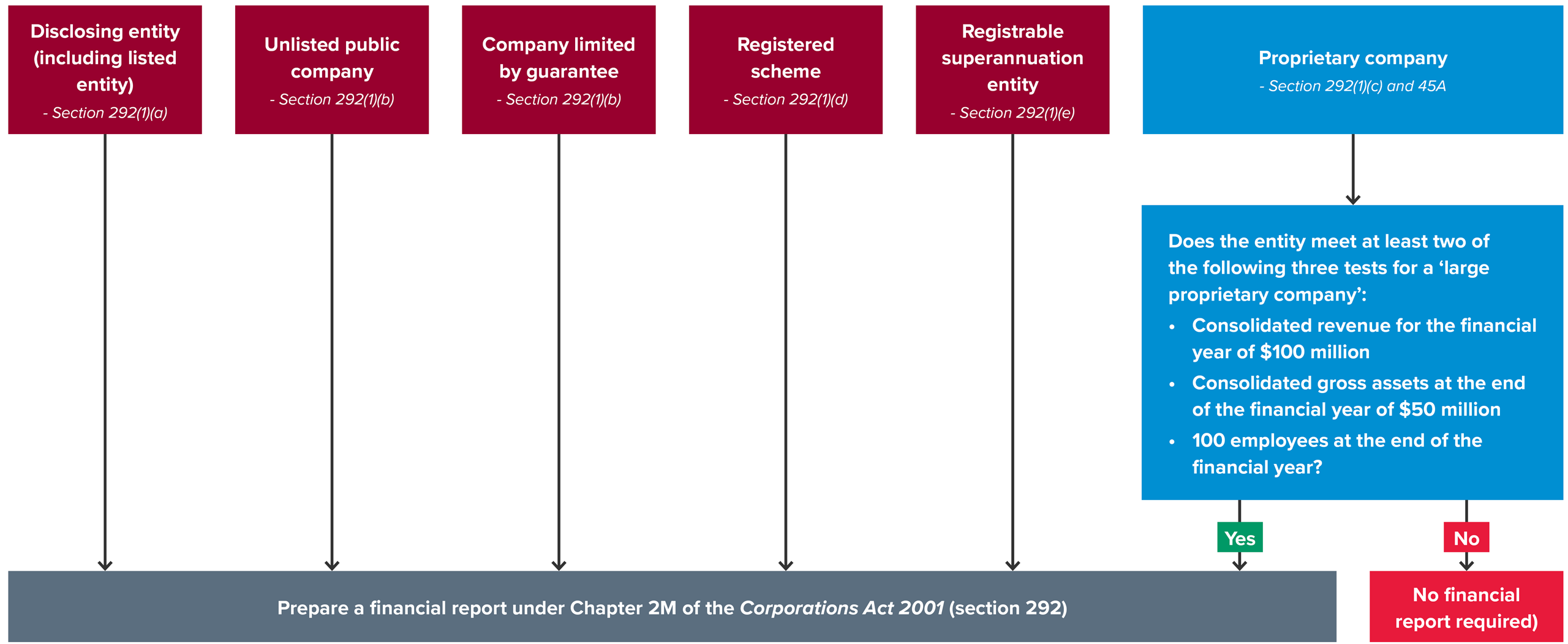
There is no change for disclosing entities (including listed entities), unlisted public companies, companies limited by guarantee and other types of entities, such as registered schemes and registrable superannuation entities. They must all lodge financial statements with ASIC, regardless of size.
The financial reporting obligations for all entities reporting under Chapter 2M of the Corporations Act 2001 are summarised in the diagram below:
What does this mean for sustainability reporting obligations?
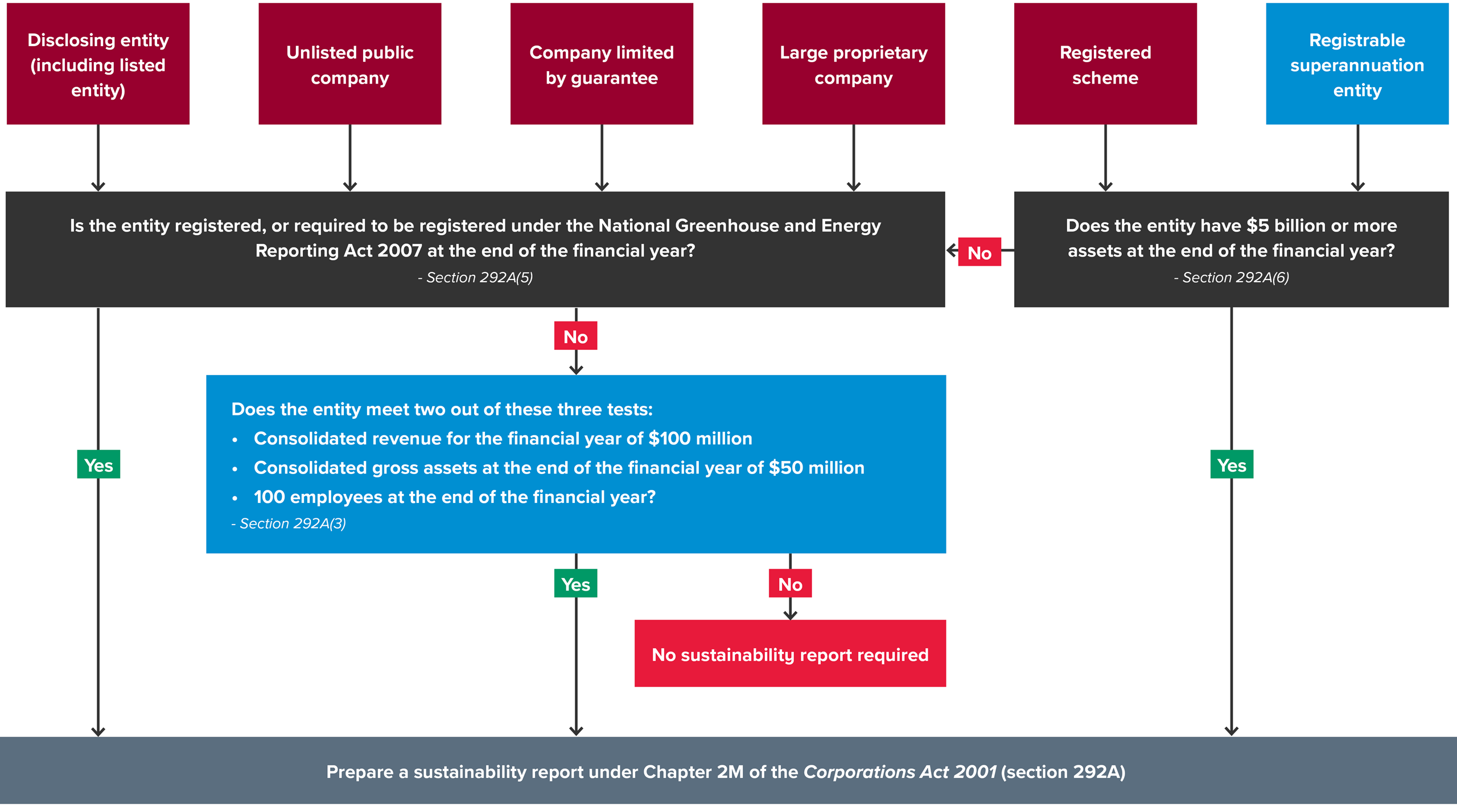
Mandatory sustainability reporting only applies to entities required to lodge financial statements with ASIC under Chapter 2M of the Corporations Act 2001 (see diagram above). For entities required to lodge, the following Group 2 entities will always have to prepare a sustainability report:
- Registered corporations or entities required to be registered under the National Greenhouse and Energy Reporting Act 2007 (NGER reporters), and
- Registered schemes, registrable superannuation entities and retail corporate collective investment vehicles (CCIVs) where the value of assets at the end of the financial year exceeds $5 billion.
In addition, other types of entities reporting to ASIC must prepare a mandatory sustainability report if they meet two of the quantitative thresholds outlined above for large proprietary companies. This is because the proprietary company thresholds are used to determine the scope of Australia’s sustainability reporting requirements.
The following diagram summarises these requirements:
Proprietary companies
Increasing the revenue and gross asset thresholds for large proprietary companies for financial years beginning on or after 1 July 2027 removes the mandatory requirement for sustainability reporting for smaller Group 3 entities. For example, without these amendments, an entity with revenue of $80 million and assets of $40 million would have had to prepare its first mandatory sustainability report for the year ended 30 June 2028.
This means there will be fewer proprietary companies lodging financial statements with ASIC, and therefore, fewer proprietary companies required to prepare a mandatory sustainability report.
Disclosing entities, unlisted public companies and companies limited by guarantee
No changes are proposed to the financial reporting obligations of other entities, such as disclosing entities (including listed entities), unlisted public companies and companies limited by guarantee. These entities would still be required to prepare a sustainability report if they are either Group 2 NGER reporters, or meet the increased thresholds outlined above.
The doubling of thresholds is likely to reduce the number of Group 3 (i.e. non-NGER) disclosing entities, unlisted public companies and companies limited by guarantee having to prepare a mandatory sustainability report.
NGER reporters
NGER reporters required to prepare a financial report must prepare a sustainability report because they are ‘Group 2’ entities.
- NGER reporters that are disclosing entities, unlisted public companies, or companies limited by guarantee: Continue to prepare a sustainability report because they must always prepare a financial report
- NGER reporters that are proprietary companies: There may be some changes (discussed below).
NGER reporters that are proprietary companies would not have to prepare a sustainability report in future if they don’t meet the higher thresholds for large proprietary company financial reporting. This means that some smaller NGER reporters operating through private companies may no longer have to prepare a sustainability report.
Example: No sustainability report
For the year ended 30 June 2028, Manufacturer Pty Limited (an NGER reporter) has consolidated revenues of $80 million and assets of $40 million. As it no longer meets the thresholds for financial reporting as a large proprietary company under section 45A, it is not required to prepare a financial report, and therefore, is not required to prepare a sustainability report.
Registered schemes and registrable superannuation entities
No changes are proposed to financial reporting obligations for these entities. If they meet the $5 billion asset threshold, these entities are always required to prepare a sustainability report. If they don’t, they only have to prepare a sustainability report if they are an NGER reporter or meet the revised quantitative thresholds outlined above.
Where to from here?
Comments on the Treasury’s consultation closed 2 November 2026. We will update you in future editions of Corporate Reporting Insights when these amendments are approved.
We are here to help
Our IFRS & Corporate Reporting and Sustainability Reporting specialists can help you navigate the complex financial reporting and sustainability reporting obligations, particularly during this initial phasing-in period.