Findings from ASIC’s financial reporting surveillance 2025-2026
Findings from ASIC’s financial reporting surveillance 2025-2026
The Australian Securities and Investments Commission (ASIC) published its findings from its financial reporting surveillance program, covering the period 1 July 2025 to 30 June 2026. The findings, contained in Report 842 ASIC’s oversight of financial reporting and audit 2025-26 (Report 842), largely highlight similar ‘problem areas’ we saw in last year’s report.
Approach and statistics
ASIC uses a risk-based approach to target financial reports for review. ASIC may then decide to review the audit file if it is concerned that a financial report may be at risk of material misstatement.
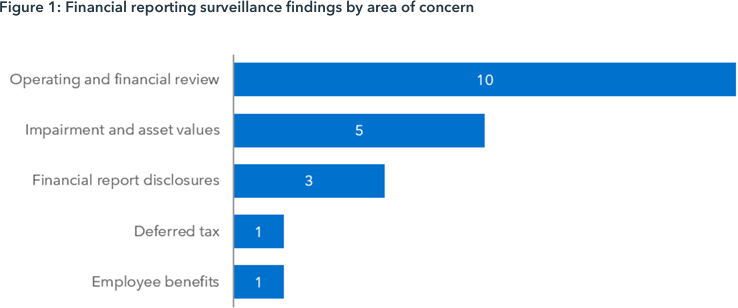
In this cycle, ASIC reviewed 353 financial reports, of which 311 were company financial reports and 42 were financial reports for registrable superannuation entities (RSEs). ASIC then contacted 30 entities, with 16 of these entities making 20 changes to their financial reports (shown in Figure 1 below and extracted from Report 842):
ASIC’s finding from its review of RSE financial reports can be found in Report 841 Accounting for your super: Super fund financial reporting and audit 2025–26.
Observations
Report 842 fleshes out ASIC’s findings and recommendations, organised into the five broad categories shown in Figure 1 above.
Operating and financial review (OFR)
Section 299A of the Corporations Act 2001 requires listed entities to include an OFR as part of their directors’ report. It should provide information that shareholders would reasonably require to make an informed assessment of the entity’s operations, financial position, business strategies and prospects for future financial years.
ASIC found that many entities still need to improve their OFR reporting. ASIC contacted 10 listed entities about the absence of disclosure about material business risks, with all either making additional disclosures or undertaking to do so in their next financial report.
What you should do
It is important to strike a balance in reporting by discussing material business risks that may affect the achievement of expected prospects. The OFR should be tailored to the entity’s circumstances and not be too generic. Directors have a duty to monitor and report risks, so it is important to have a well-developed, structured report that discusses business risks and how they might affect the business’s ability to achieve its plans. Such a process will also help the entity implement sustainability reporting standards (applicable for years ending on or after 31 December 2025 for Group 1 entities).
Regulatory Guide 247 Effective disclosure in an operating and financial review provides guidance for disclosing material business risks.
Impairment and asset values
ASIC contacted five entities (one listed, one public unlisted and three large proprietary companies) about:
- The level at which to test impairment (AASB 136 Impairment of Assets)
- Measuring intangible assets at fair value (AAS 138 Intangible Assets)
- Measuring biological assets at the lower of cost and net realisable value under AASB 102 Inventories instead of AASB 141 Agriculture
- Not recognising expected credit losses on non-current receivables from related parties (AASB 9 Financial Instruments).
As a result, one of these entities recognised an impairment expense of $558.8 million in its financial report, and the others had agreed to rectify the accounting treatment in future reports.
What you should do
Ensure appropriate systems are implemented to capture the financial and non-financial information needed to support asset values and ensure valuations are based on reasonable and supportable assumptions. For impairment testing, they should identify the smallest groups of assets with largely independent cash flows and appropriately allocate goodwill to relevant cash-generating units (CGUs). Our publication provides more information on applying the requirements of AASB 136.
Financial assets should be measured at amortised cost where the AASB 9 criteria are met, with related-party receivables and payables assessed for their terms, recoverability, credit risk and materiality. Our publication provides more information on applying the requirements of AASB 9.
Financial report disclosures
ASIC contacted one listed entity and two large proprietary companies about their specific disclosures. The listed entity failed to include a consolidated entity disclosure statement , and the two large proprietary companies did not consolidate all their subsidiaries as required by AASB 10 Consolidated Financial Statements.
What you should do
Make sure you have consolidated all subsidiaries where there is evidence of control under AASB 10. Your financial statements must also be complete – this means including a consolidated entity disclosure statement as required by section 295(3A)(a) of the Corporations Act 2001.
Tax accounting
ASIC contacted one listed entity about the recoverability of its deferred tax assets because it had recorded losses for the previous five years. As a result, the company wrote down its deferred tax assets by $4.5 million in its subsequent interim financial report.
What you should do
Ensure that sufficient taxable profits or taxable temporary differences will be available to use against the tax losses. In addition, position papers may be required to support the recognition of deferred tax assets where the entity has a history of recent tax losses. This should include appropriate analysis, conclusions and evidence to support the utilisation of tax losses.
Employee benefits
ASIC contacted one entity about the measurement of its employee benefit provisions. The entity has not included on-costs, such as superannuation, WorkCover, and payroll tax, when calculating the provision for annual leave, rostered days off and long service leave.
What you should do
Ensure that employee benefit provisions are measured at the expected future payment amount, including associated on-costs.
Auditor reporting to ASIC
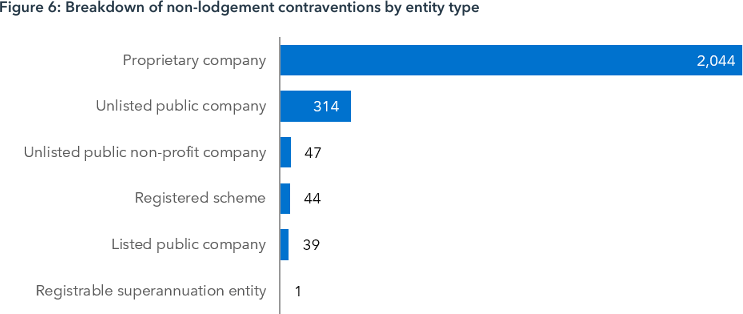
During the surveillance period, ASIC received many notifications from auditors regarding non-lodgement of financial reports, with over 80% for large proprietary companies, and almost 10% for unlisted public companies.
What you should do
If required to lodge, ensure that you submit all proprietary company financial reports with ASIC within the required timeframes . This includes entities that were previously grandfathered. Auditors are now required to report overdue financial statements to ASIC.
Sustainability reporting
ASIC also reviewed 40 sustainability reports lodged by listed and unlisted entities, with its findings documented in Report 839 ASIC’s review of sustainability reports lodged for 31 December 2025. Our article contains more information on this.
Where to from here?
ASIC will continue its financial reporting surveillance program for 2026-27, reviewing at least 200 financial reports of listed, public and large proprietary companies, 20 registrable superannuation entities and 20 managed investment schemes . The reviews will focus on:
- Revenue recognition
- Asset impairment
- Recognition and measurement of financial instruments
- Disclosure for decommissioning and site restoration costs (in light of a new guidance example in AASB 137 Provisions, Contingent Liabilities and Contingent Assets).
With the private credit sector showing signs of borrower stress and credit deterioration, ASIC is also calling on entities to refresh valuations and challenge previously used assumptions.
It will also continue its focus on the non-lodgement of financial reports by entities required to prepare and lodge them.
We are here to help
Avoiding ASIC scrutiny on financial reporting matters is crucial to prevent adjustments to financial reports, reputational issues and loss of investor confidence. So, it’s best to stay out of harm’s way and avoid the distraction of an inquiry. BDO can help ensure your financial reports are in top shape, allowing you to focus on your day-to-day business. Please contact our IFRS & Corporate Reporting team if you need help.