Key lessons from ASIC’s review of 31 December 2025 sustainability reports
Key lessons from ASIC’s review of 31 December 2025 sustainability reports
In September 2026, the Australian Securities and Investments Commission (ASIC) published Report 839, its review of Group 1 sustainability reports lodged for 31 December 2025. This is ASIC’s first detailed review of sustainability reports lodged by entities subject to Australia's new mandatory climate reporting regime, and it provides valuable insight into what reporting entities are doing well, where disclosures are falling short, and the areas likely to receive greater attention in future reporting periods.
ASIC reviewed 40 sustainability reports from a population of 312 reports lodged by Group 1 entities for 31 December 2025 year ends, covering 20 listed entities and 20 unlisted entities. ASIC prioritised sectors with higher greenhouse gas emissions and greater exposure to climate-related risks and opportunities, such as mining, utilities, manufacturing, banking and insurance.
Report 839 includes detailed observations and examples of both better and less effective disclosure, which entities should take into account when preparing future sustainability reports.
1. Overall reporting quality has improved
ASIC found that mandatory reporting has increased the quality, consistency and quantity of climate-related disclosures compared with prior voluntary reporting practices.
2. Governance and risk management disclosures were generally strong
Many entities strengthened their governance frameworks, updated their risk registers, and integrated climate risk into existing risk management processes. About 67.5% identified the board as responsible for oversight of climate risks and opportunities, and about 42.5% incorporated climate-related factors into executive remuneration in some way.
ASIC’s suggestions for improvement
- Explain how the entity assesses the nature, likelihood and magnitude of the effects of climate-related risks (refer to AASB S2, paragraph 25(a)(iii))
- For subsidiaries that are part of a larger multi-national group, disclose sufficient information for users to understand how the broader group’s governance and risk management practices apply to the reporting entity.
3. Most entities identified climate-related risks and opportunities
95% of entities identified at least one climate-related risk or opportunity that could reasonably affect their prospects over the short, medium and long-term. Common risks included flooding, cyclones, bushfires, drought, heatwaves, regulatory and technological change, and reputational impacts. Common opportunities included renewable energy, electrification and decarbonisation-related products and services.
Two entities did not identify any climate-related risks or opportunities, and the auditors included an emphasis of matter paragraph in this regard.
Other issues identified by ASIC include:
- Entities using different approaches to identify and disclose material information about climate-related risks, and it is often not clear whether a disclosed risk was inherent (before mitigation factors applied) or residual (after mitigation factors applied)
- Entities that previously disclosed to the ASX information about assets or operations being financially affected by extreme weather events did not always disclose similar risks impacting prospects over the short, medium or long-term.
4. Forward-looking disclosures need improvement
ASIC found that entities generally performed better on current-state disclosures (governance and risk management) than on forward-looking disclosures such as strategy, financial impacts, metrics, targets and climate resilience.
5. Financial effects disclosures often lacked quantitative information
37.5% of entities provided only qualitative descriptions of current and anticipated financial effects on the entity’s financial performance, financial position and cash flows. ASIC encourages entities to provide quantitative information where reasonably measurable and to explain clearly when measurement uncertainty prevents this (disclose the reason why quantitative information is not provided, and line items, totals and subtotals that are likely to be affected).
6. Climate resilience disclosures are not the same as the anticipated financial effects on prospects
AASB S2 requires entities to disclose both the anticipated financial impacts of climate-related risks and opportunities, and the resilience of their strategy and business model to those risks under different climate scenarios. While related, these are separate requirements:
- Anticipated financial effects explain how financial position, performance and cash flows are expected to change given the entity’s business as usual strategy to manage climate-related risks and opportunities
- Climate resilience focuses on the entity’s ability to adapt and respond under various scenarios.
ASIC observed that some entities combined these disclosures, providing financial impact information within their resilience analysis but failing to separately disclose the material anticipated financial effects required by AASB S2. As a result, entities should ensure they address each requirement independently and comprehensively.
7. Links between sustainability reports and financial statements were often weak
ASIC observed many examples in which climate-related expenditures, impairments or other financial impacts appeared in financial statements but were not adequately linked to sustainability report disclosures.
8. Cross-industry metrics were inconsistent
Scope 1 and 2 greenhouse gas disclosures were relatively consistent, but disclosures about vulnerable assets and business activities, and about assets and business activities aligned with climate-related opportunities and climate-related capital expenditure, varied significantly, reducing comparability between entities.
9. Many entities relied on reporting reliefs and did not disclose Scope 3 emissions
82.5% of entities used the one-year transitional relief available under AASB S2 for Scope 3 emissions. ASIC reminds entities that this relief will not be available in later years, and that future Scope 3 reporting will be important for assessing transition risk.
10. Climate-related targets set by parent entities
It was often unclear how a group-level target applied to a reporting entity or whether the reporting entity was responsible for contributing to any group level target, and to what extent. Reporting entities that are part of a larger corporate group (either within Australia or internationally) should carefully consider their users’ information needs and ensure they provide sufficient information on the application and implementation of group and entity-level climate targets.
11. No modification but two emphasis of matters
There were no modified opinions provided by the auditors for the 40 sustainability reports reviewed. However, there were two emphasis of matter paragraphs, drawing attention to the directors’ judgement that there were no climate-related risks and opportunities that could reasonably be expected to affect the entity’s prospects.
Key action points
Report 839 highlights the following key action points for reporting entities to improve their subsequent sustainability reports.
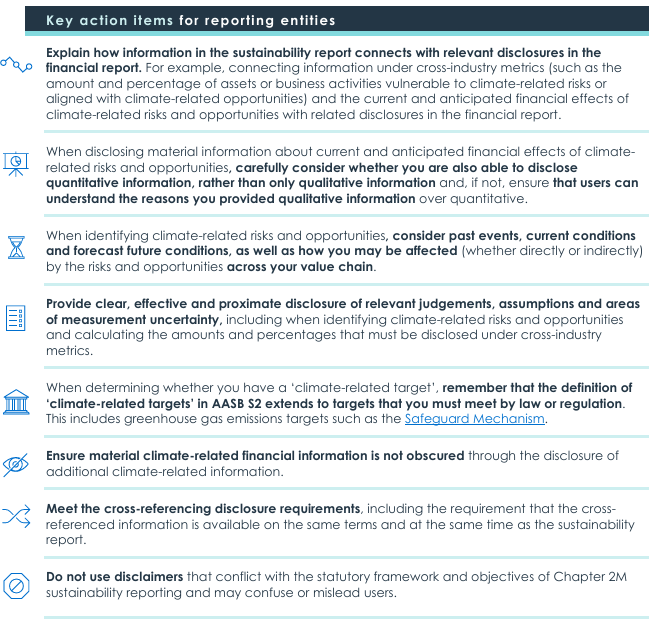
Extracted from Report 839, page 4.
Preparing for Year 2 reporting
While ASIC acknowledged improvements in reporting quality, the review highlights several areas where regulators expect more robust and relevant disclosures.
Entities should use these observations as an opportunity to review current reporting practices, challenge existing assumptions and strengthen areas identified by ASIC as requiring improvement.
For support in preparing your next sustainability report, contact BDO's sustainability reporting team.