Tier 3 NFP requirements: Consolidated and separate financial statements
Tier 3 NFP requirements: Consolidated and separate financial statements
AASB 1061 General Purpose Financial Statements – Not-for-Profit Private Sector Tier 3 Entities is a new standard that sets out simplified recognition (referred to as ‘recording’ in this article), measurement, presentation and disclosure requirements for smaller private sector not-for-profit entities (NFPs). It applies to annual periods beginning on or after 1 July 2029 and may be adopted early.
Previously, we have written about AASB 1061’s requirements for presentation, the primary financial statements and the notes. This article focuses on the simplified consolidation requirements for Tier 3 entities.
Despite the early adoption option, until legislators clarify which entities can use it, we recommend that private-sector NFPs carefully consider and seek advice on adopting AASB 1061 before 1 July 2029.
Except in limited circumstances, a parent entity preparing Tier 2 financial statements under AASB 1060 General Purpose Financial Statements – Simplified Disclosures for For-Profit and Not-for-Profit Tier 2 Entities must present consolidated financial statements if it has investments in subsidiaries. Despite the additional implementation guidance in Appendix E, consolidation is often one of the most challenging aspects for preparers of NFP financial statements. Indeed, the requirement to present consolidated financial statements was often the reason many NFPs have, to date, prepared special purpose financial statements.
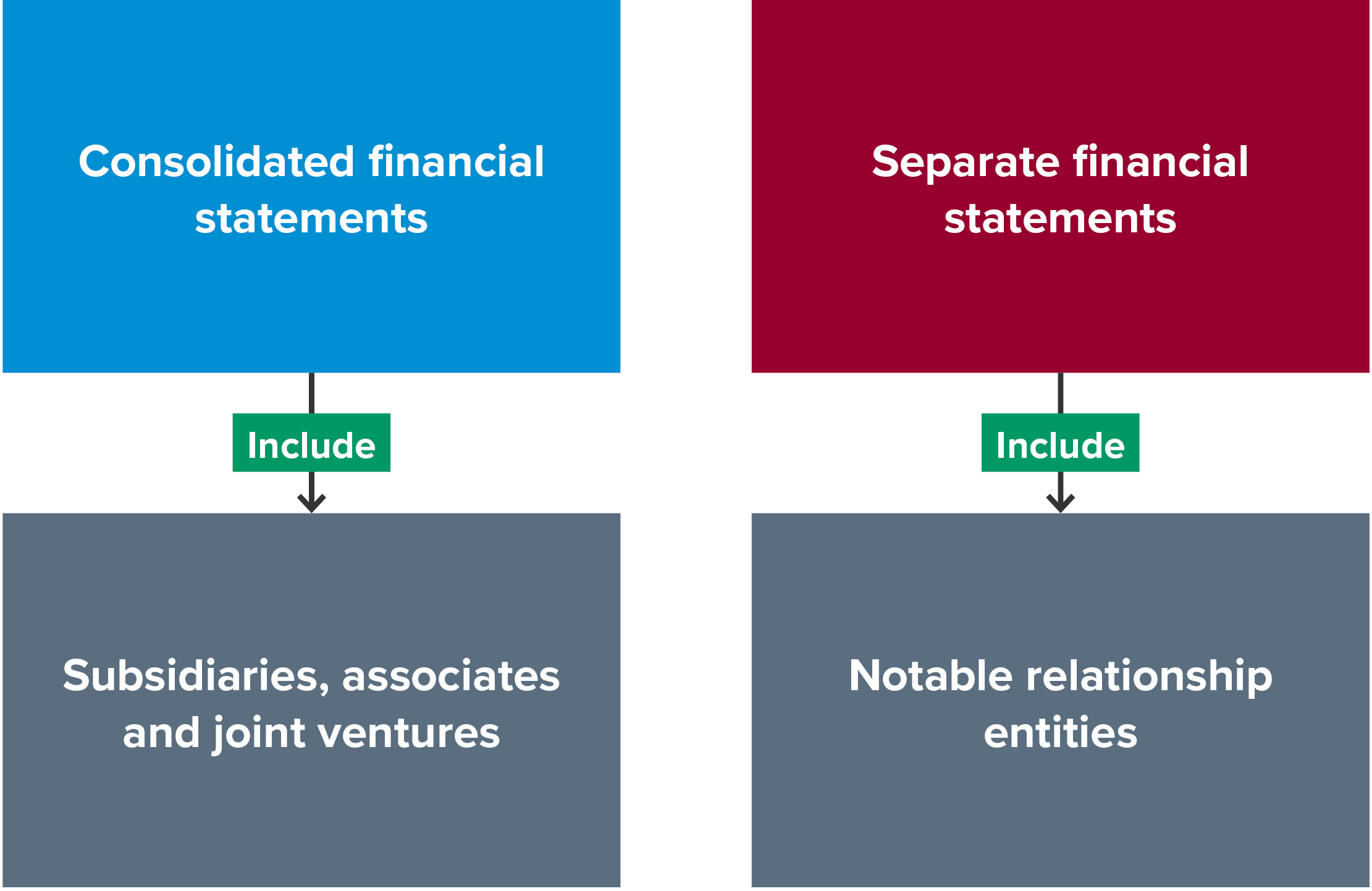
AASB 1061 simplifies the consolidation requirements for Tier 3 NFP entities by providing a choice to either present consolidated financial statements or separate financial statements (with no consolidation).
When must a NFP prepare consolidated financial statements?
A parent entity (investor) must present consolidated financial statements if it controls another entity (investee). It may also choose to present separate financial statements, in addition to the consolidated financial statements (paragraph 8.2).
Consolidated financial statements must include all subsidiaries of the parent entity and must equity account all investments in associates and joint ventures.
The consolidation procedures in AASB 1061 are broadly consistent with the Tier 2 consolidation requirements contained in AASB 10. However, there may be some differences, for example:
- AASB 1061, paragraphs 8.23 and 8.24, do not specify what happens to accumulated other comprehensive income (OCI) relating to a former subsidiary when control is lost
- AASB 10, paragraph B98(c) and B99 require amounts previously recognised in OCI to be reclassified to profit or loss or transferred directly to retained earnings, following the treatment that would apply on disposal of the underlying asset or liability.
Can parent entities choose not to present consolidated financial statements?
Yes, they can. Although paragraph 8.2 says that a parent entity ‘shall’ (must) present consolidated financial statements, paragraph 8.3 then permits an investor to choose not to present consolidated financial statements.
If the investor chooses not to present consolidated financial statements, it collectively classifies all the following types of investments as a single class of assets called ‘investments in notable relationship entities’:
- Subsidiaries
- Associates
- Interests in joint arrangements that involve a separate vehicle (a joint venture).
In such cases, the parent entity prepares separate financial statements as its only financial statements.
An arrangement over which the entity has joint control, but that is not structured through a separate vehicle (e.g. some joint operations), is never a notable relationship entity. Instead, such arrangements are accounted for in accordance with Section 13: Investments in Associates and Interests in Joint Arrangements, of AASB 1061.
Where consolidated financial statements are not prepared, AASB 1061 requires an entity to treat all these relationships as a single class of assets. That is, interests in notable relationship entities will be a separate line item in the balance sheet in the investor’s separate financial statements.
What is a notable relationship entity?
Although AASB 1061 gives an investor the choice to collectively classify its investments in subsidiaries, associates and joint ventures as ‘notable relationship entities’, in practice, the NFP may not know whether its investments are subsidiaries, associates or joint ventures because conducting such an assessment is too time-consuming, difficult and/or judgemental.
AASB 1061 has simplified this assessment process. Basically, a ‘notable relationship entity’ is one in which the investor has the power, at a minimum, to participate in the financial and operating policy decisions of the investee. This occurs when the investor has at least significant influence over the investee.
Note that holding an equity interest is not a prerequisite for an investor to be able to participate in the financial and operating policy decisions of the investee.
Significant influence is usually evidenced in one or more of the following ways:
- Representation on the board of directors or equivalent governing body of the investee
- Participation in policy-making processes, including participation in decisions about distributions of any surpluses
- Material transactions between the two entities
- Interchange of managerial personnel, and
- Provision of essential technical information.
Deciding whether the investor has significant influence over the investee requires judgement. For example:
- Significant influence presumed: Entity holds, directly or indirectly, 20 per cent or more of the voting power of an investee
- Significant influence not presumed: Entity holds, directly or indirectly, less than 20 per cent of the voting power of the investee.
In the above instances, significant influence is presumed/not presumed unless it can be clearly demonstrated otherwise.
Potential voting rights that are currently exercisable or convertible (including those held by other entities) are also considered when assessing whether an entity has significant influence.
What are separate financial statements?
Separate financial statements are:
- The financial statements presented by an investor that accounts for investments in notable relationship entities
- A second set of financial statements that a parent elects to present in addition to consolidated financial statements
- A second set of financial statements that an investor (which is not a parent but has one or more investments in associates or joint ventures) elects to present in addition to its individual financial statements, which have equity accounted its investments in associates and joint ventures.
How are investments measured in separate financial statements?
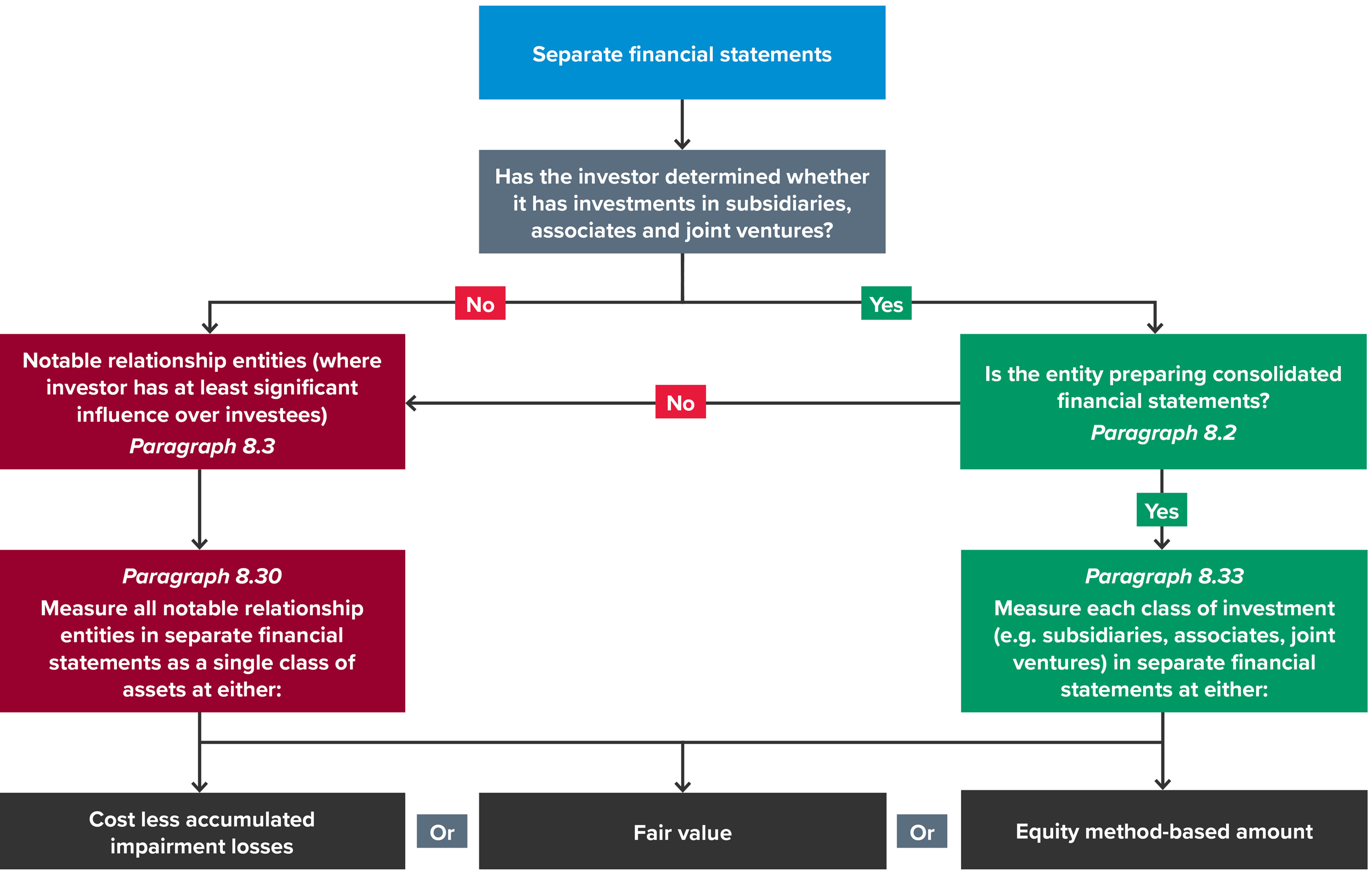
The rules for measuring investments in separate financial statements differ, depending on whether the investor has determined whether it has investments in subsidiaries, associates and joint ventures. This is shown in the diagram below.
Separate financial statements with investments in notable relationship entities
If the investor has not assessed whether it has investments in subsidiaries, associates and joint ventures, and has elected to collectively classify its investments as notable relationship entities, it must choose to measure all investments in notable relationship entities at either:
- Cost, less any accumulated impairment losses (determined by referring to the requirements in Section 10 for identifying and measuring impairment of financial assets measured at cost)
- Fair value, or
- Equity method-based amount (determined by following the equity accounting procedures in paragraph 13.22).
It is important to note that all investments in notable relationship entities are treated as a single class of assets, and the investor must apply the same measurement accounting policy to all such investments, including future notable relationship investments.
Example: Notable relationship entities
Entity A does not assess whether it has investments in subsidiaries, associates and joint ventures.
Entity A has investments in Entity X, Entity Y and Entity Z. It collectively classifies all three investments as notable relationship entities because it has at least significant influence in all of them.
In its separate financial statements, being the entity’s only financial statements, Entity A can measure all investments in notable relationship entities at cost, all at fair value, or all using the equity method-based amount.
Separate financial statements in addition to consolidated/equity-accounted financial statements
As noted above, a parent entity can choose to present separate financial statements as a second set of financial statements in addition to consolidated financial statements. An investor with one or more investments in associates or joint ventures can make a similar choice.
The parent or investor can choose to measure these investments in subsidiaries, associates and joint ventures using the same three measurement options available for notable relationship entities. However, each class of investment can use a different measurement basis.
Example: Investments in subsidiaries, associates and joint ventures
Entity B has assessed that it has investments in subsidiaries, associates and joint ventures and has elected to prepare consolidated financial statements.
Entity B wishes to present separate financial statements in addition to its consolidated financial statements.
Entity B can choose to measure each class of investment using one of the three methods noted above. For example, it can choose to measure subsidiaries at cost, associates at fair value, and joint ventures using the equity method-based amount.
However, Entity B cannot choose to measure some subsidiaries at cost and some using another measurement basis.
If a parent entity or investor has determined that it has investments in subsidiaries, associates or joint ventures but chooses NOT to prepare consolidated or equity accounted financial statements, it must prepare separate financial statements for its investments in notable relationship entities.
Fair value measurement
Where fair value is selected as the measurement basis, changes in fair value are recognised in profit or loss, unless the investor makes an irrevocable election to present fair value changes in OCI (FVTOCI). However, the criterion for making this irrevocable election differs as follows:
|
Type of investment |
When to make an irrevocable election for FVTOCI |
Implication |
|
Investment in notable relationship entities |
On the initial recording of the first asset in the class of assets called ‘investments in notable relationship entities’ |
An election cannot be made after the first investment in a notable relationship entity has been recognised |
|
Investments in subsidiaries, associates and joint ventures |
On the initial recording of its first investment in each class of asset. |
An election can be made the first time that a subsidiary, associate or joint venture is recognised. |
Entities transitioning to Tier 3 for the first time can make the irrevocable election to present these investments at FVTOCI based on facts and circumstances that exist on the date of transition, as if the date of transition were the date of initial recording of the first asset in the class.
Disclosures in separate financial statements
For all entities preparing separate financial statements, the following additional disclosures are required:
- The fact that the financial statements are separate financial statements
- A description of the method(s) used to account for its:
- Investments in notable relationship entities (all would have the same measurement basis), or
- Investments in subsidiaries, associates and joint ventures (each could have a different measurement basis).
In addition to the related party disclosures required by Section 27, an entity must disclose for each notable relationship entity:
- The name of the notable relationship entity
- A description of the notable relationship entity’s primary purpose and an indication of the nature of its operations
- A description of the notable relationship entity’s relationship with the reporting entity (for example, that the entities operate a partnership, that the reporting entity is able to appoint the key management personnel of the notable relationship entity, or that the entity controls the notable relationship entity)
- Whether the notable relationship entity prepares audited or reviewed financial statements.
Other considerations
Points for entities to consider regarding the Tier 3 reporting framework:
- AASB 1061 uses simplified, but sometimes similar, wording that may nevertheless result in potential recognition and measurement differences compared to Tier 1/Tier 2 general purpose financial statements
- If/how these consolidation simplifications will affect the thresholds for reporting once legislators decide who can apply AAS B 1061.
More information
For more information, please refer to our previous articles on Tier 3 reporting for private sector NFPs:
We are here to help
Whilst AASB 1061 simplifies the requirements for eligible entities, navigating the financial reporting framework for NFPs is currently a complex exercise because regulators have not yet addressed the existence of Tier 3. In addition, the requirements for general purpose financial statements (GPFS), which kick in in 2029 will be challenging for many NFPs currently preparing special purpose financial statements (SPFS), and the transition effort required to move from SPFS to a form of GPFS should not be under-estimated. Please contact our IFRS & Corporate Reporting team if you need help deciphering the new standards.