Which entities can recognise income from investments in associates and joint ventures as ‘operating’ under IFRS 18?
In June 2026, the International Accounting Standards Board (IASB) issued amendments to IAS 28 Investments in Associates and Joint Ventures. The amendments clarify which entities can use the fair value through profit or loss (FVTPL) option to measure their investments in associates and joint ventures. They also have flow-on effects on how income from these investments is classified in the statement of profit or loss under IFRS 18 Presentation and Disclosure in Financial Statements.
How are investments in associates and joint ventures measured?
An investor that has joint control over a joint venture, or significant influence over an associate generally measures these investments using the equity method of accounting. After initial recognition, the equity method results in the investment’s carrying amount:
- Increasing or decreasing to recognise the investor’s share of the post-acquisition profit or loss of the investee
- Decreasing for the effect of distributions received from the investee.
Equity accounting is not the same as measuring such an investment at FVTPL.
Exemptions from applying the equity method
IAS 28, paragraphs 18 and 19 provide exemptions to the general equity accounting rule for investments in associates and joint ventures when they (or a portion thereof) are held directly or indirectly through an entity that is a:
- Venture capital organisation, or
- Mutual fund, unit trust and similar entities, including investment-linked insurance funds.
In such cases, on initial recognition, the entity (investor) could choose, on an investment-by-investment basis, to measure the investment at FVTPL in accordance with IFRS 9 Financial Instruments, rather than using the equity method.
Why is the measurement basis important for IFRS 18 income and expense classification?
IFRS 18 requires that income and expenses relating to investments in associates and joint ventures be classified in the ‘investing category’ in the statement of profit or loss if they are accounted for using the equity method of accounting. This rule applies regardless of whether the entity has a specified main business activity of investing in these types of assets (see diagram below).
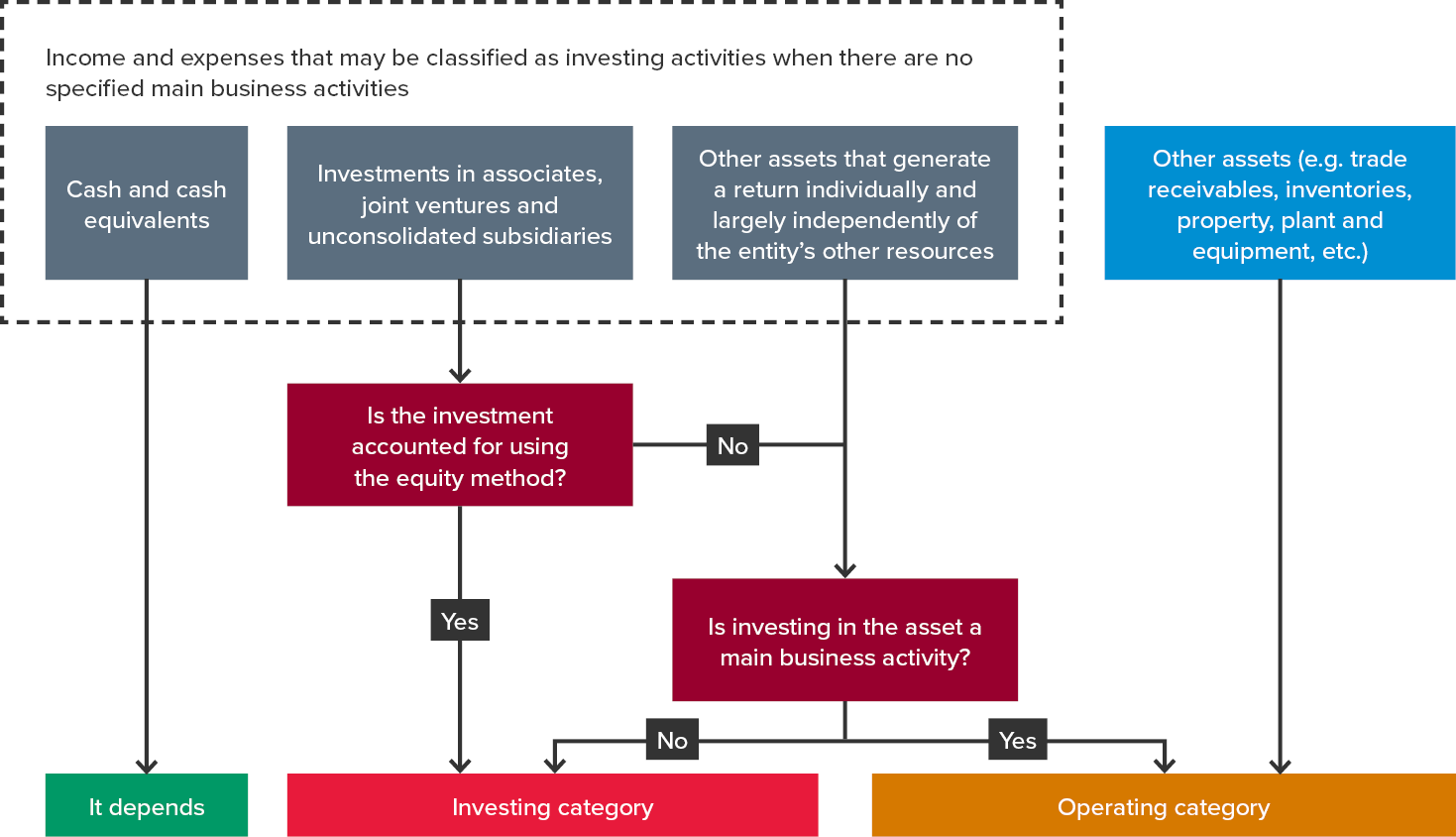
However, if the investment is not accounted for using the equity method (i.e. one of the exemptions for using fair value applies), and the entity invests in assets as a main business activity, any fair value movements in the carrying amount of the investment will instead be classified in the ‘operating’ category.
Any entities forced into equity accounting for investments in associates and joint ventures because they don’t meet the exemption criteria for fair value measurement could, therefore, never classify the related income and expenses in the ‘operating’ category in the statement of profit or loss under IFRS 18.
Why were amendments to IAS 28 needed?
Stakeholders in the insurance industry made the IASB aware that there was diversity in how the exemption criteria were being applied in practice, particularly regarding the lack of clarity about the meaning of ‘similar entities including investment-linked insurance funds’. The IASB, therefore, decided to:
- Make targeted amendments to IAS 28 to clarify that ‘similar entities’ include entities that have a main business activity of investing in assets, and
- Delete the example of an investment-linked insurance fund from the exemption criteria.
When do these amendments apply?
The amendments are effective from when an entity first applies IFRS 18.
Note: IFRS 18 must be applied in Australia by:
- For-profit entities for annual periods beginning on or after 1 January 2027
- Not-for-profit entities, and superannuation entities applying AASB 1056 Superannuation Entities for annual periods beginning on or after 1 January 2028 (the Australian Accounting Standards Board is currently considering whether any adjustments are needed to the IFRS 18 requirements for these entities).
Transitional requirements
If an entity applies these IAS 28 amendments when it initially applies IFRS 18, it must do so in accordance with paragraph C7 of IFRS 18. This means:
- It is permitted to change its election for measuring an investment in an associate or joint venture from the equity method to FVTPL in accordance with IFRS 9
- It must apply any such change retrospectively, applying IAS 8 Basis of Preparation of Financial Statements.
If an entity early adopted IFRS 18 for a period that commenced before these amendments were issued, it must apply the amendments, in accordance with paragraph C7 of IFRS 18, for the reporting period ending on or after the amendments were issued. For example, if the entity applied IFRS 18 to the annual period beginning on or after 1 January 2026, it must apply the amendments to the annual period ending 31 December 2026.
More information
Please refer to our insights for more information on this topic.
Need help?
Reach out to our team if you need help assessing whether your entity has a main business activity of investing in associates and joint ventures that are not accounted for using the equity method. Merely measuring them at fair value is not enough to classify the related income and expenses in the operating category in the statement of profit or loss.