Gender pay gap employer statement – our commitment to inclusion, gender equality and diversity
BDO is committed to an inclusive culture, one where our people feel they belong and can bring their true selves to work every single day. We value the differences and unique perspectives of every individual in our team.
Gender equality, including closing the gender pay gap and ensuring all our people are equitably rewarded, is a key priority for our firm. Our Board-endorsed Gender Equality strategy aligns with our firm strategy and formalises our active commitment to gender equality in the workplace.
Improving gender equality is critical to our success because it ensures an inclusive and safe environment for all our people, and strengthens our quality of thought, collaboration, and perspective. This all leads to even stronger ideas and solutions for our clients and a better experience for our people.
The firm’s Executive Leadership Team, led by our Chief Executive Partner, David Garvey, in conjunction with the BDO Australia Limited Board, plays a vital governance role to ensure the firm is meeting its inclusive culture and gender equality objectives.
2024-25 WGEA Gender Pay Gap analysis
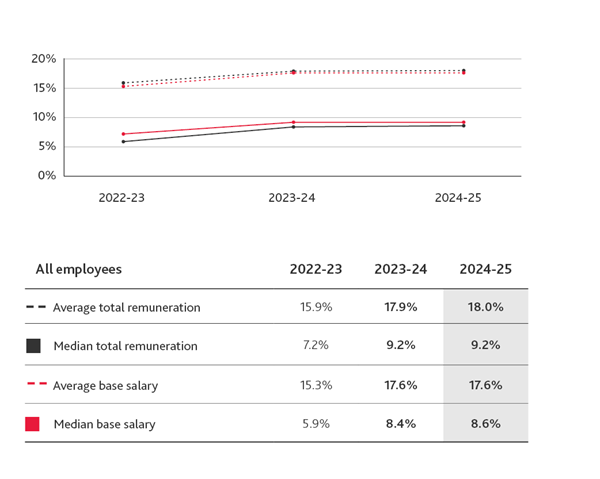
Gender pay gap over time
Notes:
- Total remuneration includes base salary, overtime, bonuses and additional payments. It also includes the annualised full-time equivalent salaries of casual and part-time workers.
- The average gender pay gap (GPG) is the difference between the average earnings for men and women, expressed as a percentage of men's average earnings.
- The median GPG is the difference between the median of what men are paid and the median of what women are paid, expressed as a percentage of the median man's earnings [median is the value in the middle of the dataset].
- From the 2023-2024 reporting period onwards, following legislative reforms, the Workplace Gender Equality Agency (WGEA) included ‘CEO’, ‘Head of Business’ and ‘Casual Manager’ remuneration data in the GPG calculation for all reporting organisations’ GPG. This negatively impacted our GPG data relative to the 2022-2023 reporting period.
- The data set is inclusive of Partners as they are considered employees in our company structure.
BDO’s average total remuneration gender pay gap (GPG) for 2024-25, as reported by the Workplace Gender Equality Agency (WGEA), is 18.0% and the median total remuneration GPG is 9.2%. This is relatively the same as the previous reporting period. The GPG midpoint in our Comparison Group (Professional, Scientific and Technical Services), as reported in our WGEA industry benchmark report, is 15.1% for the average total remuneration GPG and 16.7% for the median total remuneration GPG.
In line with our company structure (we are not structured as a partnership in the legal sense of that term), all our Partners are included in our annual gender equality reporting to the WGEA. Excluding our Partner cohort, our average total remuneration GPG is 2.7%, and our median total remuneration GPG is -3.7%¹.
Gender composition and average remuneration by pay quartile
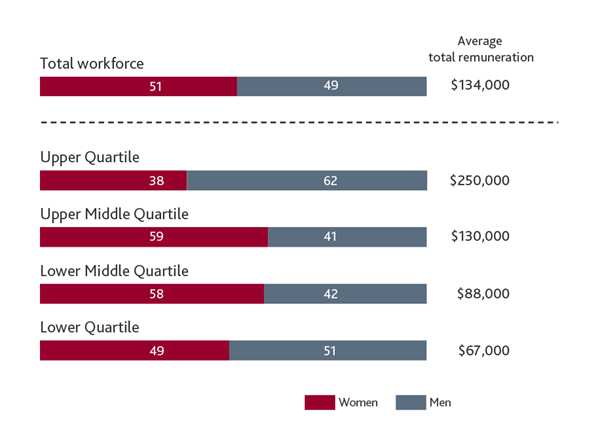
The chart below divides the total remuneration full-time equivalent pay of all employees into four equal quartiles, by gender.
Notes:
- Total remuneration for part-time and casual employees is converted to annualised, full-time equivalent amounts.
- The average total remuneration has been rounded to the nearest $1000.
At 31 March 2025, women represent 51% of BDO’s total workforce, however there is a disproportionate concentration of men in the upper quartile (62%), where the average total remuneration is significantly higher than other quartiles. Partners and senior leaders account for a large portion of this quartile.
Our representation of women in Partner roles is 24% (as at 1 February 2026), which is below our firm target of 30% women Partners by 2029. We have made progress in building our internal pipeline and are pleased that a large proportion of women hold C-Suite and Shared Services leadership roles, including our Partner, Chief Strategy Officer; Partner, Chief Operating Officer; Chief Financial Officer; Chief Client Officer; and Chief Information Officer. As outlined in our action plan below, we continue to take proactive steps to ensure our women progress into partnership and other leadership roles across the firm and develop their careers at BDO. This will in turn ensure a more gender-balanced upper quartile in future.
Factors influencing our gender pay gap
Key factors contributing to the firm’s gender pay gap include:
- A higher representation of men in senior roles, particularly at Partner level
- Conversely, a higher representation of women in administrative and support roles
- More women than men taking periods of parental leave, meaning women are out of the workforce for longer.
Our Gender Equality Strategy and gender pay gap action plan
Our Gender Equality Strategy sets out a multi-pronged approach to achieving better gender balance across all levels of the firm, particularly at the senior levels, while tackling systemic and cultural factors that can contribute to the gender pay gap. We are also prioritising leadership accountability.
Key actions and measures to reduce the gender pay gap include:
- Continuing our regular gender pay gap analysis - this includes investigating and analysing our pay data before, during and after our remuneration review cycle, ensuring a gender lens is applied to all pay decisions, and addressing any discrepancies.
- Target setting and monitoring - in addition to setting a gender pay gap target of 14.5%, we have committed to the following targets to help drive progress, particularly in the senior ranks (and we are in the process of establishing additional targets):
- 30% women Partners by 2029
- 40% women candidates shortlisted for lateral hire Partner roles (ongoing)
- 40% women internally promoted per promotion cycle (ongoing).
- Fostering inclusive leadership and visibility - investing in building inclusive leadership skills, networks like Women@BDO, and creating avenues for senior women to be visible and influential across the firm.
- Building a balanced pipeline of future leaders
- Increasing the number of women in senior roles - by supporting women’s development and upward career mobility, the firm can cultivate a more diverse and representative workforce over time.
- Continued development of our early career pipeline - this ensures a long-term sustainable approach to talent.
- Greater gender balance at non-manager levels - we are implementing actions to increase the representation of men in non-manager roles e.g. in Shared Services, thereby improving gender balance.
- Ensuring fair and equitable reward practices - ongoing, rigorous reviews of remuneration practices is essential to closing the gender pay gap. By regularly evaluating reward structures and performance assessments, the firm cements its commitment to fair and equitable remuneration.
The above actions and measures are supported by our inclusion networks and range of policies and practices - such as Gender Equality, Family Support, Flexible Working - to help ensure equitable access to opportunities and support for all our people.
Removing barriers to the equal participation of women in the workplace resulting from historical, social and economic factors requires cultural change. We are making progress, but we know there is more to be done. This is why BDO’s commitment to inclusion and gender equality is formalised in our firm strategy and governed by our Executive Leadership Team and Board.
¹ The Workplace Gender Equality Agency considers gender pay gaps between -5% and +5% as neutral. This target range allows for normal fluctuations in the workforce.