Comparing greenhouse gas reporting under AASB S2 and NGER
Comparing greenhouse gas reporting under AASB S2 and NGER
Entities reporting climate-related financial information under AASB S2 Climate-related Disclosures must disclose their absolute gross greenhouse gas (GHG) emissions generated during the reporting period for Scope 1, Scope 2 and Scope 3 emissions.
What framework must an entity use to report its GHG emissions?
Paragraph 29(a)(i) of AASB S2 requires an entity to report its Scope 1, Scope 2 and Scope 3 GHG emissions, expressed in metric tonnes of CO2 equivalent.
Paragraph 29(a)(ii) of AASB S2 requires GHG emissions to be measured in accordance with the Greenhouse Gas Protocol: A Corporate Accounting and Reporting Standard (2004) (the GHG Protocol). This applies unless a jurisdictional authority or listed exchange requires the use of a different method (alternative method), with the standard permitting entities to measure their GHG emissions using the GHG Protocol for some parts of their business and an alternative method required by a jurisdictional authority or listed exchange for other parts.
Does a jurisdictional authority in Australia require entities to measure their emissions using a basis other than the GHG Protocol?
The National Greenhouse Energy and Reporting Act 2007 (NGER scheme) requires certain heavy emitters (NGER reporters) to report their Scope 1 and Scope 2 emissions (expressed in tonnes of CO2 equivalent) using the methodology set out in the National Greenhouse and Energy Reporting (Measurement) Determination 2008. The NGER scheme does not require an NGER reporter to measure or disclose its Scope 3 emissions.
This means that entities required to prepare a sustainability report in accordance with AASB S2, who must also report emissions under the NGER scheme, will be able to use their Scope 1 and Scope 2 emissions calculated in accordance with the NGER scheme methodology to meet their requirements under Paragraph 29(a). However, as explained below, an entity is likely to have to ‘top up’ the emissions it reported under the NGER scheme to meet the requirements under AASB S2.
Is the reporting period for NGER the same as for AASB S2?
Entities that are required to prepare a sustainability report in accordance with AASB S2 must report their Scope 1, Scope 2 and Scope 3 emissions for the same reporting entity as the related financial statements (unless otherwise permitted by law), covering the same reporting period as the financial statements, and it must be consistent with the corresponding data and assumptions used in preparing the related financial statements.
This period may be different from the NGER reporting period, which is for the Australian financial year (1 July to 30 June). Entities with financial year-ends other than 30 June may need to adjust their NGER-reported Scope 1 and Scope 2 emissions to align with their financial reporting period.
NGER reporters will require a ‘top-up’ to their emissions for AASB S2 reporting
Under the NGER scheme, the corporation or facility required to report its Scope 1 and 2 emissions may differ from the group required to report its emissions under AASB S2. This is illustrated in the diagram below.
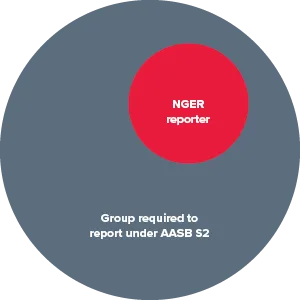
Therefore, entities preparing an AASB S2 compliant sustainability report will need to top-up the emissions reported under the NGER scheme to include:
- Scope 3 emissions, measured in accordance with the GHG protocol, for the part of the entity that reports under the NGER scheme, and
- Include Scope 1, Scope 2 and Scope 3 emissions for the remaining parts of the group measured in accordance with the GHG protocol.
Setting the inventory boundary for groups that include NGER reporters
The NGER scheme requires the operational control approach to be used to determine the inventory boundary, whereas entities reporting under AASB S2 may select one of three permitted approaches (the operational control approach, financial control approach, or equity share approach) to determine the inventory boundary.
Any entities that use the emissions calculated for NGER reporting purposes in their sustainability report will therefore need to use the operational control approach when setting their inventory boundary.
Differences in the measurement of emissions when applying the GHG protocol to measure emissions versus the NGER scheme
Further differences exist when measuring GHG emissions when applying the GHG protocol in the context of AASB S2 or when applying the NGER scheme requirements, including:
|
|
NGER scheme requirements |
AASB S2 - using GHG Protocol requirements |
|
Methodology to calculate emissions |
Scope 1 emissionsNGER reporters must use one of four prescribed methods to calculate Scope 1 emissions. |
Scope 1 emissionsSelect an approach that is appropriate to the entity. Methods could include a process-based approach using direct measurement or estimation techniques. |
Scope 2 emissionsLocation‑based reporting is required. Limited use of a market‑based approach is permitted under specific NGER rules, subject to consistency requirements across facilities. |
Scope 2 emissionsA location‑based calculation is required. Entities must also provide additional information where contracts or instruments are used to explain how electricity emissions are sourced. |
|
Scope 3 emissionsNo requirement to calculate or report Scope 3 emissions. |
Scope 3 emissionsEntities are required to assess emissions across the full value chain, drawing on all categories defined in the GHG Protocol’s Scope 3 framework, using AASB S2’s measurement guidance. |
|
|
Greenhouse gases measured |
Greenhouse gases are defined in the Act as six of the gases listed in the Kyoto Protocol: 1. Carbon dioxide (CO2) 2. Methane (CH4) 3. Nitrous oxide (N2O) 4. Hydrofluorocarbons (HFCs) 5. Perfluorocarbons (PFCs) 6. Sulphur hexafluoride (SF6). |
Greenhouse gases include the seven gases listed in the Kyoto Protocol: 1. Carbon dioxide (CO2) 2. Methane (CH4) 3. Nitrous oxide (N2O) 4. Hydrofluorocarbons (HFCs) 5. Perfluorocarbons (PFCs) 6. Sulphur hexafluoride (SF6) 7. Nitrogen trifluoride (NF3). |
|
Use of emission factors |
NGER reporters generally apply the default emission factors set out in the National Greenhouse and Energy Reporting (Measurement) Determination 2008. |
Select emission factors that best reflect the entity's activities and circumstances. |
|
Global warming potentials used to calculate the CO2 equivalent |
Prescribed in the Act from the IPCC’s Fifth assessment report. |
Should use the latest IPCC report, currently the Sixth assessment report. However, if the emissions factor used already converts the activity to its CO2 equivalent (even using an older assessment report), there is no need to recalculate using the latest assessment report. |
More information
You can find more information about the differences between NGER and AASB S2 emissions calculations in the high-level comparison published by the Australian Accounting Standards Board and the Commonwealth Scientific and Industrial Research Organisation (CSIRO) and in our previous article Why NGER and GHG Protocol aren’t enough for AASB S2 compliance.
Need help?
Please reach out to our carbon accounting experts if you need help calculating your GHG emissions for AASB S2 and NGER reporting.