One-size does not fit all: How data-driven localisation gives retailers an edge
One-size does not fit all: How data-driven localisation gives retailers an edge
This article has been adapted for the Australian retail context from content originally published by BDO USA.
Recently, many of your friends have been raving about a specific bag from your favourite brand, and you’ve seen influencers review it on your social media feed. It would be great for your daily commute, but unfortunately, the bag is so hot the store is sold out. The retailer just can’t keep the item in stock to meet demand.
This is a disappointment many customers go through, but in the not-so-distant future, things will look different. The retailer of the future will tap into social media, consumer data, and their own sales data to build a deeper understanding of consumer behaviour. They will have insights that sales of this bag are blowing up in Sydney but have been slow to move in Brisbane. These future-ready retailers will be able to use their digital supply chain and logistics technology to move bags to Sydney stores, keeping the shelves stocked and the sales flowing.
Why localised assortment is becoming a commercial priority
Australian retailers operate across diverse geographies and markets where demand can vary significantly, with a mix of major cities, fast‑growing outer‑metro areas and regional centres. When range and inventory decisions are made well before products reach the store, it becomes harder to respond when local demand shifts.
By using customer, sales and inventory data, retailers can analyse local shopping habits and product preferences to tailor their product assortment and improve sell-through. With customer data analytics, retailers can build an assortment strategy that is highly customised and data driven and help drive sales growth.
It’s not just higher sales, however, that retailers can expect from a shift to a localised assortment strategy. Tailoring the product assortment can help reduce supply chain and warehousing costs, and improve inventory turnover by preventing retailers from stocking unnecessary products.
Given the current geo-political environment and increasing material and logistics costs impacting margins significantly, this strategy could help retailers maintain the bottom line. Naturally, it may be more difficult for geographically dispersed retailers to get localised product assortment right, as this would require them to study diverse customer habits across locations. But with today’s technology and advancement in AI, retailers have access to behavioural insights like never before.
Turning data points into customer stories
Retailers looking to stay competitive will know what their customers need by gathering data points such as their location, shopping habits, and social media and browsing data. Retailers can also gather store data such as the sell-through of different products. Once there is sufficient data to build a few customer profiles, retailers can strategically order and market in-demand items. In the future, retailers will no longer need to ask customers what they want, but surmise what the customer plans to purchase before the customer even knows themselves.
Developing a localised assortment strategy depends on correctly capturing, interpreting, and analysing customer data, collected internally and through third-party sources.
The first step in this process is determining what customer data to analyse. The illustration below provides some sources of data to help drive local product assortment strategy.
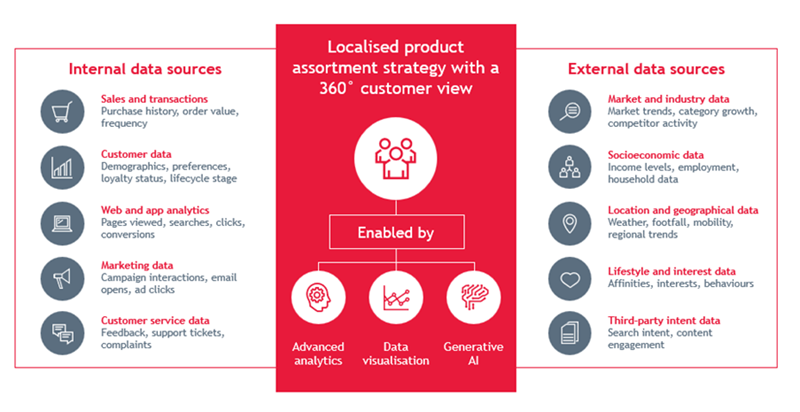
The right CRM system can segment data by geographic locations to identify patterns and trends. While data based on a customer’s region or city may generate notable insights, retailers can get even more granular if customers have granted permission to let the retailer’s app or website access their location. Retailers may consider grouping customers together based on “micro regions,” using address or postcode data to cluster together.
Paired with their owned first-party data, third-party data can contribute to the development of robust customer profiles and associated product strategies. Once a retailer has determined the appropriate sources for customer data, data scientists will need to organise and cleanse that data, so it is ready for visualisation.
Retailers who want to future proof will increasingly leverage AI. AI and advanced analytics can accelerate the process of trend identification to inform localised assortment strategies via pattern mapping. AI can often find patterns that humans may miss.
Marrying customer data with supply chain logistics to future proof your inventory
Organising customer data and identifying trends and patterns among local customer groups is a key step in developing an effective assortment strategy. Understanding how preferences show up in local buying patterns helps retailers determine what products to place in each location. These insights are typically supported by AI and advanced analytics, including generative AI, which can surface patterns and enable more tailored product recommendations.
However, determining the “what” is only half the challenge. The other half is the “how,” or aligning supply chains so the right products reach the right stores at the right time.
Connected logistics data, including GPS tracking, sensors and inventory management systems, enables retailers to identify bottlenecks, respond to emerging demand and quickly address out-of-stock issues. These same technologies also support smarter in-store execution, from replenishment through to product placement.
This highlights the importance of translating demand insight into effective execution on the shop floor, including how and where products are displayed in-store.
Using data analytics, AI, and inventory management technology together is key to delivering an effective localised assortment strategy. Making these tools work cohesively, however, often requires specialist skills and experience, which is where the right advisory support can help.
The retailers that will succeed in the future will be able to offer their customers choice, but tailor those choices to precise customer segments. As a retailer, you may have collected plenty of customer data, but you will need to be able to organise and interpret that data to get the insights you need in driving key business decisions.
How BDO supports localised retail strategies
BDO’s retail team works with clients across Australia to combine data analytics and AI and supply chain insight, helping retailers design localised assortment strategies that improve sell-through, protect margin and support smarter inventory decisions to stay competitive today and in the future.
This article is part of our series Future-proofing Australian retail.