
BDO Economic Landscape Report - South Australia 2024/25

Rising complexity, rural disparity, and resilient growth

South Australia’s (SA) economy stands at a crossroads. The 2024/25 BDO Economic Landscape Report reveals a state defined by its strong services sector, slow but stable growth, and rising economic complexity. While Adelaide continues to drive healthy expansion, much of rural SA faces significant challenges, with severe drought leading to negative growth in many regions. This report provides a comprehensive, data-driven analysis to help policymakers, businesses, and communities make informed decisions for the future.

Explore the data: Dive deeper into South Australia’s economic landscape

Download the full report

Executive summary

  • SA’s economic complexity score increased in 2024/25, now ranking just behind VIC and NSW, signalling a shift towards more knowledge-intensive industries
  • Despite a challenging year for rural regions, total employment in SA reached over 1.06 million people, with Adelaide accounting for nearly 68 per cent of all jobs
  • The services sector continues to underpin the state’s resilience, but construction and mining also contributed notably to GSP growth this year
  • Regional income growth was uneven: while Adelaide’s income rose by 1.2 per cent, some rural regions saw stagnation or minor declines
  • The state’s economic diversity remains the highest in Australia, cushioning against sector-specific downturns and supporting stable employment and wages.
Anders Magnusson

“South Australia boasts the most diverse economy among Australian states, which enhances resilience, reduces vulnerability to sector-specific shocks, and stabilises employment and wages. But published statistics can obscure significant regional disparities. The impact of the drought on regional economies has been masked by the growth in Adelaide, and with SA’s population heavily concentrated in the capital city, many people might not be aware of the reality faced by our agriculture, forestry and fishing communities.” 

Anders Magnusson
Chief Economist, BDO
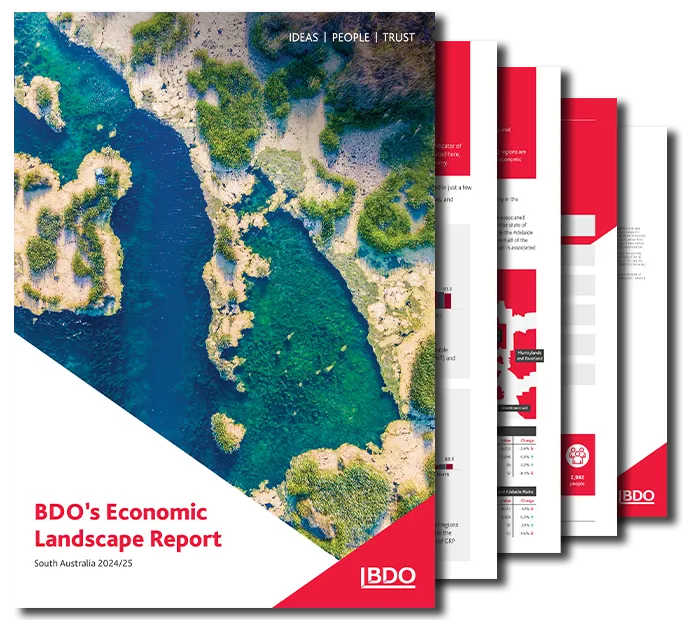

Economic Landscape Report

Key insights

Statewide trends

  • Services sector dominance: 86 per cent of GSP is now generated by services, particularly professional services, health, education, and finance.
  • Regional disparities: Adelaide’s economy grew by 1.8 per cent, close to the ten-year average, while rural regions like the Murraylands and Riverland saw contractions of up to 2.6% per cent due to drought.
  • Economic diversity and complexity: SA leads the nation in economic diversity, supporting resilience and long-term growth. Complexity is rising, reflecting a shift toward higher-value, knowledge-intensive industries.
  • Productivity: Statewide productivity rose to $99 GSP per hour worked, driven by mining and improvements in Adelaide, but remains a challenge in rural areas.

Regional Economic Performance (GRP Change)

Adelaide Metropolitan

+1.8%

Healthy growth, services-led.

Murraylands & Riverland

-2.6%

Severe drought impact, rural downturn.

Far North

-0.5%

Income up 2.4% despite GRP contraction, driven by mining.

Adelaide Hills, Fleurieu & KI

+0.4%

Modest GRP growth, employment up 2.7%.

Limestone Coast

-2.5%

GRP decline, drought impact on agriculture and related sectors.

Yorke and Mid North

-2.0%

GRP decline, drought impact on agriculture and related sectors.

Methodology

The BDO Economic Landscape Report is underpinned by a robust, modelled dataset that describes the South Australian economy across every local government area and 86 industries, spanning four financial years (2021/22 to 2024/25). Our approach:

  • Data integration: We combine key sources, including the ABS State Accounts, Labour Accounts, Labour Force Survey, and Census, using a human-guided, iterative optimisation process to reconcile differences and ensure accuracy.
  • Alignment with official statistics: The model is calibrated to align with flagship ABS publications, providing confidence in the reliability and comparability of our findings.
  • Granular analysis: The report delivers fine-grained insights at both industry and regional levels, enabling users to identify trends, allocate resources, and respond proactively to emerging risks.
  • Key indicators: We calculate and track economic diversity (modified Herfindahl–Hirschman Index), complexity (PMHS complexity index), and labour productivity (GRP per hour worked), offering a comprehensive view of SA’s economic health.

This methodology ensures the report is not only comprehensive but also practical, empowering decision-makers with the evidence needed for strategic planning and policy development.

About the team

BDO’s economics team are multidisciplinary problem solvers, combining deep technical expertise with a practical, client-focused approach. Our economists, analysts, and sector specialists work closely with clients across government, business, and the not-for-profit sector to deliver:

  • Economic and social research
  • Project and programme evaluation
  • Economic modelling and impact analysis
  • Industry and market analysis
  • Socioeconomic profiling.

Authors