Investment strategies for not-for-profits
Investment strategies for not-for-profits
For many not-for-profit (NFP) organisations, investment decisions are about more than generating a financial return. They are about protecting resources, maintaining the capacity to deliver services, and ensuring funds continue to support the organisation’s purpose over the long term. Our recent webinar from Oliver Straker, Tessa Erikson, Russell Postle, and Luke Shepherd discussed the key considerations for NFPs when developing an investment strategy, governance frameworks, investment policy statements, ancillary fund obligations, and practical approaches to investing beyond term deposits.
Start with an Investment Policy Statement
An Investment Policy Statement (IPS) provides the framework for how a NFP makes and governs its investment decisions. It records how and why funds are invested and provides continuity when board members, executives, or advisers change.
An IPS, at a minimum, should define:
- The organisation’s objectives and the role its investments play in supporting them
- The required return and investment timeframe
- Roles, responsibilities, and approval authorities
- Liquidity and cash reserve requirements
- Risk parameters, asset allocation ranges, permitted and restricted investments
- Ethical, environmental, and social considerations
- Performance monitoring and reporting arrangements
- How frequently the policy will be reviewed.
The IPS should be approved by the board and reviewed regularly to ensure it remains appropriate. An effective IPS is more than an investment document, it’s a board-level governance and risk management tool.
Consider the different dimensions of risk
Investment risk should not only be assessed by asking how much market volatility an organisation is willing to accept but also consider three connected dimensions.
- Risk required: The level of investment risk that may be needed to achieve objectives. An organisation looking only to preserve purchasing power may require a different strategy from one seeking returns above inflation to fund future programs or distributions.
- Risk capacity: The organisation’s financial ability to withstand fluctuations without affecting its operations. Stable funding, strong cash reserves, and a long investment horizon may increase that capacity. Alternatively, uncertain revenue, significant upcoming expenditure, or reliance on investment income to meet operating costs may reduce it.
- Risk tolerance: The board’s comfort level with fluctuations in portfolio value. If a 10 to 15 per cent decline would prompt a strategy change, the portfolio may be taking more risk than the organisation can sustain.
An appropriate strategy sits at the intersection of these considerations, it should generate the required returns while remaining within the organisation’s financial capacity and the board’s tolerance for volatility.
Establish the right level of cash reserves and look beyond term deposit rates
Before investing surplus funds, an organisation must determine how much cash should remain readily available. Reserve levels should reflect month to month cash requirements and at least current liabilities. The organisation should also ‘stress test’ worst case scenarios such as 3 years’ worth of potential losses and any large capital requirements.
Scenario planning can help boards test how the organisation might perform in a difficult year, such as lower membership income, or reduced activity revenue. This helps determine the cash buffer required before remaining funds are considered for longer-term investment. Funds required for an asset purchase, development, or other major project may not be suitable for investment. IPS and reserve calculations should be adjusted based on future expenditure and worst-case revenues.
Term deposits can provide certainty and capital protection, but boards should consider the real return after inflation and the effect of rollover risk. Over the last few years, we have noted lower than CPI (inflation) returns from cash (including term deposits). Below we have charted a basket of Term Deposits against Australian CPI (inflation).
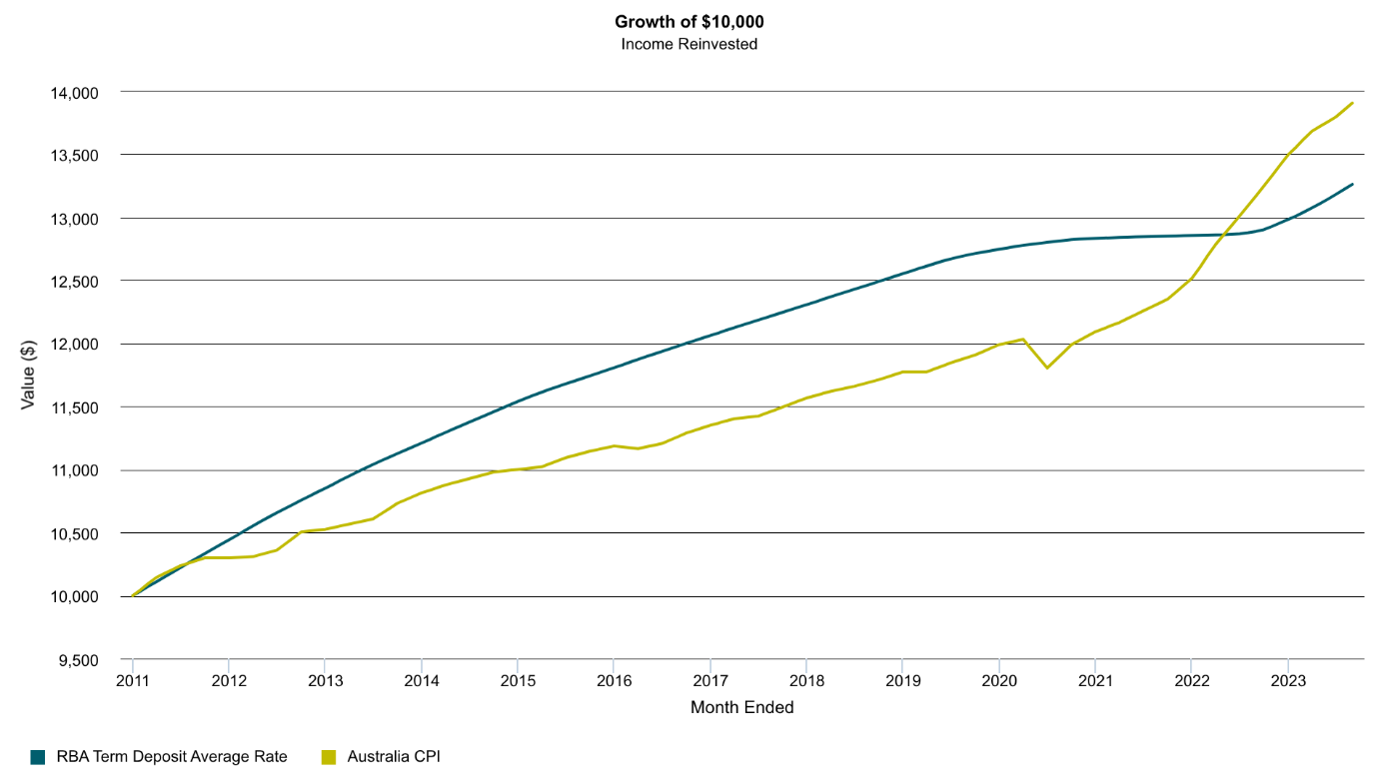 Source: Lonsec
Rather than moving all available cash into growth assets, organisations can separate funds by purpose and timeframe – operational cash, reserves funds, and longer-term capital suitable for a diversified investment strategy.
Diversification to balance growth and resilience while aligning to organisational values
Once liquidity requirements and risk settings are clear, the organisation can consider an appropriate investment mix. A diversified portfolio may include cash, term deposits, fixed income, and growth assets.
Bonds may provide a step between cash and equities, offering a more predictable income stream than shares, although risks vary by issuer, structure, and credit quality. Equities may deliver stronger long-term growth but can experience significant short-term declines. The right allocation will depend on objectives, timeframe, and the ability to withstand volatility. Boards should recognise that recovery after a major downturn can take years, so funds needed during that period should not be exposed to unsuitable market risk.
Alongside identifying the right allocations, an organisation’s investments should align with the purpose and values expressed in its governing documents. For example, environmental or public health organisations may restrict exposure to activities that conflict with their mission. Exclusion policies should be specific and implementable. Broad restrictions can unintentionally capture businesses with incidental exposure.
The full cost of advice
Fees can have a meaningful effect on net performance, particularly for smaller portfolios. Boards need to understand the full cost of advice, including adviser fees, platform costs, and the investment-management fees or indirect costs associated with underlying funds. Adviser selection should not be based on fees alone, experience with NFPs, governance arrangements, independence, ethical investment approaches, and the quality of reporting provided should also be considered.
Distribution requirements and considerations for ancillary funds
Private and public ancillary funds have specific governance, compliance, and distribution obligations that should be considered as part of any investment strategy. While these structures differ in their governance arrangements, both are designed to hold and invest philanthropic capital in support of charitable purposes and must meet minimum annual distribution requirements. Current distribution settings, together with any proposed reforms, should be considered alongside liquidity, capital preservation, and risk objectives. Higher distribution requirements may place additional pressure on liquidity and long-term sustainability, particularly where funds seek to preserve the real value of capital against inflation and may require higher investment returns to meet both distribution and capital preservation objectives.
As investment returns can vary from year to year, boards should consider the possibility of meeting distribution obligations during market downturns and factor these scenarios into cash-flow forecasting, distribution planning, and investment policies. Maintaining appropriate records and regularly reviewing investment and governance arrangements can help boards understand how investment decisions may affect future distributions, liquidity and the fund’s ability to sustain its charitable purpose over the long term.
Keep governance and charitable purpose at the centre
Investment decisions should be aligned with the organisation’s charitable purpose and governing documents. Boards should regularly review whether investment activities remain consistent with their purpose and whether organisational priorities have changed over time. Ancillary funds should take care when making distributions, including confirming that intended recipients are eligible to receive distributions, including verifying the recipient’s DGR1 status, before funds are distributed. Regular review of governing documents and the IPS helps investment and operational decisions stay aligned with purpose.
An NFP investment strategy should help the organisation deliver its purpose, not distract from it. There is no single portfolio or reserve level that suits every organisation, the right approach brings together purpose, governance, liquidity, risk, timeframe, costs, and compliance. Establishing a clear IPS, maintaining appropriate reserves and reviewing strategy as organisational circumstances change, means boards can make more informed decisions about how capital supports the organisations present needs and its long-term impact.
How BDO can help
We work with not-for-profit organisations to develop investment governance frameworks, review Investment Policy Statements, assess reserve strategies, and navigate ancillary fund obligations. Contact our not-for-profit team to discuss your organisation’s objectives.
Watch the full webinar here.
Disclaimer: This publication has been carefully prepared, but is general commentary only. This publication is not legal or financial advice and should not be relied upon as such. The information in this publication is subject to change at any time and therefore we give no assurance or warranty that the information is current when read. The publication cannot be relied upon to cover any specific situation and you should not act, or refrain from acting, upon the information contained therein without obtaining specific professional advice. Please contact the BDO member firms in Australia to discuss these matters in the context of your particular circumstances.
Each BDO member firm in Australia, their partners and/or directors, employees and agents do not give any warranty as to the accuracy, reliability or completeness of information contained in this publication nor do they accept or assume any liability or duty of care for any loss arising from any action taken or not taken by anyone in reliance on the information in this publication or for any decision based on it, except in so far as any liability under statute cannot be excluded.
A.C.N. 050 110 275 Ltd ABN 77 050 110 275, an Australian company limited by guarantee, is a member of BDO International Ltd, a UK company limited by guarantee, and forms part of the international BDO network of independent member firms. BDO is the brand name for the BDO network and for each of the BDO member firms.
© 2026 A.C.N. 050 110 275 Ltd. All rights reserved.