The untapped potential of organic waste
The untapped potential of organic waste
Organic waste, such as food and garden organics (FO, GO and FOGO), is one of Australia’s most underutilised resources. Around 40 per cent still ends up in landfill, driving up methane emissions and forfeiting the opportunity to generate high-value products, such as compost and bioenergy.
Despite policy developments aimed at landfill diversion, challenges such as contamination, inconsistent regulations, and limited infrastructure hinder progress. BDO’s waste and resource recovery specialists have examined the significant opportunity in Australia's organic waste landscape, exploring key challenges, technological advancements, and strategic pathways to maximise resource recovery.
For councils and commercial & industrial (C&I) generators alike, organics recovery is quickly becoming a budget issue, not just an environmental one, as levies, gate fees and service expectations rise.
The state of organic waste management
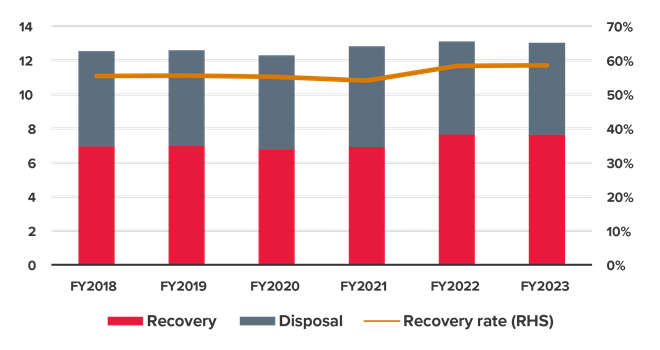
The national data highlights the scale of the opportunity. According to the Department of Climate Change, Energy, the Environment and Water’s National waste and resources recovery report 2024, Australia generated approximately 13.0 million tonnes of organic waste. Slow progress has been made in diverting organics away from landfill, with the recovery rate improving from 51 per cent in FY2015 to 59 per cent in FY2023. However, recovery rates have stagnated over the past five years, with no significant improvement and approximately 5.4 million tonnes of organic waste still ending up in landfill annually.
Figure 1: Organics recovery and disposal (Mt) and recovery rate trend FY2018 to FY20231
There is currently no unified national approach to organics collection and processing in Australia, with policy and infrastructure varying significantly across states:
- New South Wales has legislated a statewide FOGO mandate requiring FOGO collection for all households by 2030 and many businesses by 2026
- Victoria is introducing a four-bin waste system, with mandatory FOGO services by 2030. 71 per cent of councils report that all households in their area have access to a FOGO service
- South Australia achieves the highest diversion rate, with FOGO collection services widely available through local councils, though no statewide mandate exists
- Queensland is actively working towards expanding kerbside organics collection in line with its Organics Strategy 2022-2032
- Western Australia is piloting programs to expand FOGO services, with all local governments in the Perth and Peel regions required to implement FOGO by 2025
- Australian Capital Territory is advancing with targeted FOGO pilot programs, aiming for full rollout by 2026
- Northern Territory currently has no kerbside organics services due to economic feasibility challenges, but a Circular Economy Strategy is in place to leverage the value in waste.
While these state-level initiatives are encouraging, a nationally consistent framework would help overcome fragmentation and enable the scaling up of organics recovery.
Choosing the right technology to balance cost and impact
Effective organic waste recovery depends on choosing appropriate processing technologies that are balanced against cost constraints. Composting and Anaerobic Digestion (AD) are the primary treatment methods, each with unique advantages depending on feedstock quality and contamination levels.
- Composting for GO and FOGO produce high-quality soil amendments when contamination is minimised
- AD is suited to high-energy organic waste such as FO with low contamination, generating biogas that can be used for electricity or converted into biomethane
- High contamination levels in municipal solid waste (MSW) FOGO streams reduce the viability of both technologies, necessitating pre-processing solutions. In these instances, legislating the rollout of organics services may lead to unintended consequences if not supported by adequate education and ancillary infrastructure.
The economic viability of organic waste processing depends heavily on feedstock quality, processing infrastructure, pre-processing investments, and potential funding support. These economic factors highlight the need for strategic planning to optimise the location, scale, and integration of processing infrastructure.
To unlock the full potential of organic waste in Australia, a technology-neutral approach will allow the appropriate solution to be assessed and tailored to the requirements of a given project. The most suitable processing solution will be one that strikes the right balance between contamination management, cost-effectiveness, and the strength of end-market demand for recovered products.
The benefits and challenges of organics processing
Processing organic waste through composting and/or AD offers multiple environmental and economic benefits, but realising this potential requires a nuanced, regionally tailored approach. Opportunities and the practical realities on the ground include:
- Environmental gains: Composting improves soil health, enhances water retention, and reduces reliance on synthetic fertilisers. Diverting organics to alternative waste technologies also reduces greenhouse gas emissions from landfill
- Renewable energy generation: AD offers a pathway to local renewable energy, with biogas production reducing fossil fuel reliance. However, the viability of AD depends on consistent feedstock quality and long-term market signals such as project economics
- Economic growth: The expansion of organics processing is forecast to drive investment, which will create new jobs across collection, processing, and secondary product markets
- Potential cost savings: As landfill levies and gate fees rise, organics diversion becomes increasingly cost-effective
- Supports a circular economy: Organics processing is central to circular economy ambitions, transforming waste into compost, soil conditioners, and renewable energy. However, market development for these products remains a critical enabler.
Despite its benefits, several challenges must be addressed for the successful scale-up of organic waste processing:
- Contamination: Rising contamination rates (particularly plastics and glass fines) are a major operational and market risk. High-quality, source-separated organics reduce processing costs and improve end-product value, but require real-time monitoring and community education interventions
- Processing capacity: Many states lack sufficient facilities to handle large-scale organic waste processing. While new facilities are planned, industry investment is contingent on clear rollout timelines and contracts of sufficient term
- Regulatory inconsistencies: A historically fragmented service implementation could be assisted through the regulatory environment and national standardisation
- Market development barriers: Fluctuating demand for compost and organic-derived products impacts financial viability, creating a risk that these products have a lower commercial value compared to synthetic alternatives
- Community resistance: Social licence remains an issue, with odour, encroachment on buffer zones, noise, facility siting, and increased truck movements being key community concerns. Early and ongoing engagement, transparent communication, and robust monitoring are essential to build trust and support for new infrastructure.
What’s next? Strategies for scaling organics recovery
To maximise organics recovery, a coordinated approach is needed, focusing on:
- Prioritising cleaner waste streams: Commercial & industrial (C&I) organic waste is generally less contaminated than MSW. A focus on C&I, in addition to MSW, will support organics recovery
- Informed technology selection: Fit for purpose technology should be used for high-energy waste streams, while composting remains a robust solution for garden waste and other MSW organics
- Stronger policy and funding support: Incentives and regulatory support for councils and businesses investing in organics processing infrastructure could help achieve recovery targets
- National consistency in standards: Harmonising organics collection and processing guidelines across states could improve industry efficiency
- Public engagement and education: Raising awareness about waste separation and contamination reduction is essential for successful service rollouts.
Building a circular future for waste recovery
Australia has made significant strides in organic waste recovery, yet key barriers remain in achieving a fully circular approach. By leveraging cleaner waste streams, optimising technology choices, and enhancing policy coordination, Australia can transform organic waste into a valuable resource. A strategic, well-supported approach will be essential to achieving long-term environmental and economic benefits, accelerating the nation’s transition to a sustainable and resource-efficient future.
BDO’s waste and circular economy team can assist your organisation in identifying and evaluating opportunities to reduce costs and improve efficiency through strategic planning, feasibility assessment, market analysis, and financial modelling. Contact our team or learn more about our waste and environmental infrastructure services to optimise your waste operations and increase profitability.